IsoEnergy Provides 2025 Athabasca Basin Exploration Update and Prepares to Launch Winter Exploration Programs Including Drilling at Larocque East
Highlights
-
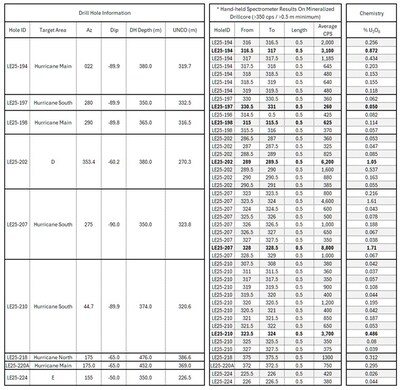
Resource expansion drilling returned strongly anomalous geochemistry results along the Hurricane Main and South trends that validate previously reported radiometric results (Table1)
.
- LE25-194 intersected 0.872% U3O8 over 0.5 m within a 3.5 m interval, averaging 0.313% U3O8 in the basal sandstone along the Hurricane Main Trend 80 m east of the deposit.
- LE25-207 intersected 1.61% U3O8 over 0.5 m in the basal sandstone immediately above the unconformity along the Hurricane South Trend 240 m east of the deposit. A second 0.5 m interval, 4.5 m below the unconformity, returned 1.71% U3O8.
-
Larocque Trend
–
Area D geochemistry validates best uranium intersection to d
ate outside of the Hurricane Deposit
.
- Geochemical results have confirmed that winter drill hole LE25-202, completed 2.8 km east of the deposit in Target Area D, returned the strongest uranium intersection to date on the Larocque East project outside the Hurricane area.
- LE25-202 intersected 1.05% U3O8 over 0.5 m about 20 m down hole from the unconformity in a broader interval that returned 0.583% U3O8 over 1.5 m.
-
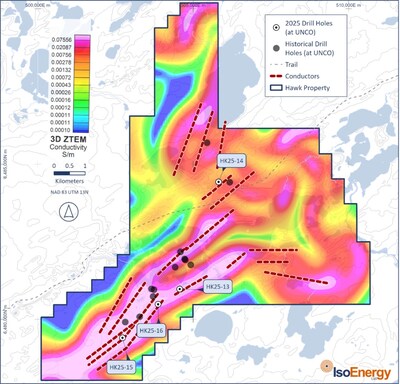
Hawk Project – Key elements of prospective unconformity uranium geology continue to be intersected in widely spaced drill holes on this early-stage exploration project.- HK25-13 and HK25-16 intersected graphitic gneisses and faults along the previously untested eastern conductor (Figure 2).
- HK25-14 intersected two significant intervals of structural disruption and prospective alteration in the sandstone in the northern portion of the project where only two other holes have been drilled.
- Upcoming winter drilling at Larocque East is expected to build on encouraging results to date – Planning is well advanced, with 5,200 m in 13 holes anticipated. Integration of summer exploration results with existing interpretations is underway to finalize 2026 drill targets and the winter work program, with additional details to be provided in due course.
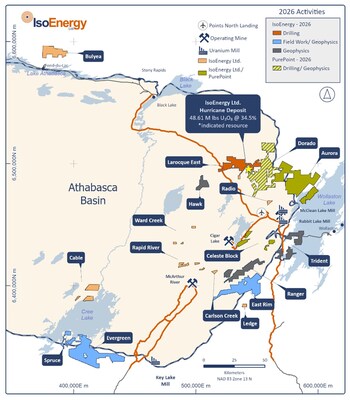
- Additional work is planned in 2026 to develop drill targets on highly prospective projects –Geophysical surveys and interpretation are planned at the Evergreen, East Rim, Ranger, Trident and Hawk projects (Figure 3).
-
IsoEnergy strengthens its management team with the appointment of Ms.Misty Urbatsch as Vice President, Strategy and Commercial, bringing extensive uranium exploration and marketing experience from her years with Cameco and direct experience exploring for uranium in both in theAthabasca Basin andAustralia .
Hurricane Resource Expansion Drilling
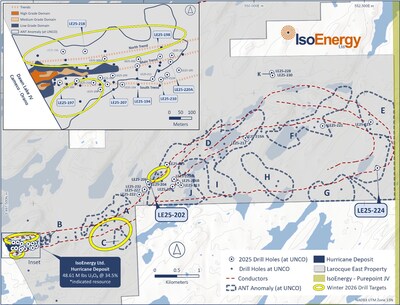
Mineralized intervals, defined as zones averaging ≥350 cps over a minimum length of 0.5 m of core, were intersected in nine drill holes from the 2025 drill program (Table 1). Continued testing of potential resource expansion targets at Hurricane will be a focus of the planned winter 2026 drill program (Figure 1). Radioactivity results from six mineralized holes from the winter program were previously reported (see news release dated
Results from the uranium geochemistry analysis are based on continuous split core samples collected through radioactive zones. The Company is still awaiting a large volume of geochemical data from composite samples taken through the sandstone and basement from the summer drill holes. The interpretation of the pathfinder element geochemistry for the Laroque Trend will be updated once these sample results are received.
Main Trend Highlights
Significantly elevated uranium geochemistry was returned from winter drill holes LE25-194 and LE25-198, as well as summer drill holes LE25-220A and LE25-231, which were drilled on the Hurricane Main Trend east of the deposit. LE25-203, drilled in the winter north of LE25-194, did not intersect significantly elevated radioactivity.
LE25-194, located 80 metres east of the Hurricane deposit, intersected a 3.5 m interval in the basal sandstone immediately above the unconformity at 319.7 m in which drill core radioactivity ranged from 480 to 3,100 cps over 0.5 m intervals. Anomalous geochemical results correlate well with the previously reported radioactivity. The best value in a 0.5 m sample is 0.872% U3O8, and the broader 3.5 m interval averaged 0.313% U3O8. The spectral mineralogy of the sandstone in LE25-194 is dominated by illite, with lesser kaolinite and dickite, for 90 m up hole of the unconformity. Illite is the dominant clay mineral in alteration zones associated with most
LE25-198, drilled 110 m east of LE25-194, intersected 0.114% U3O8 over 0.5 m in the basal sandstone 1.0 m above the unconformity at 316.5 m. An average of 625 cps had been measured on core in the same 0.5 m interval. The spectral mineralogy of the sandstone column is dominated by illite, with lesser kaolinite and dickite for 115 m up hole of the unconformity.
LE25-220A intersected the unconformity 150 m east of LE25-194 at a depth of 369.0 m. The sandstone clay mineral spectroscopy is dominated by strong illite, with lesser kaolinite, and an almost complete absence of background dickite for 100 m up hole from the unconformity. Immediately below the unconformity, a 0.5 m interval returned 0.295% U3O8, which correlates with an average of 750 cps, within a zone of strong, pervasive clay alteration.
LE25-231 intersected the unconformity 15 m north of LE25-220A. It intersected an average of 313 cps measured on the core over a 1.0 m interval 1.0 m below the unconformity at 326.0 m, within a strongly bleached and clay-altered semipelitic gneiss. Geochemistry results are pending.
South Trend Highlights
Intervals of significantly elevated uranium geochemistry returned from winter drill holes LE25-207 and LE25-210 on the Hurricane South Trend correlate with radioactive intervals measured on drill core.
LE25-207 was drilled 240 m east of the deposit and intersected the unconformity at 323.8 m. It returned 1.61% U3O8 over a 0.5 m interval in the basal sandstone immediately above the unconformity where drill core radioactivity averaged 4,600 cps over the same interval. Additionally, a second 0.5 m interval 4.5 m below the unconformity, returned 1.71% U3O8 where drill core radioactivity averaged 8,800 cps.
LE25-210 was drilled 480 m east of Hurricane and intersected the unconformity at 320.6 m. It returned 0.486% U3O8 over a 0.5 m interval, located three metres below the unconformity, where drill core radioactivity averaged 3,700 cps over the same interval. This interval is within a 2.5 m interval that extends from 1.5 m above the unconformity to 1.0 m below the unconformity that returned an average of 0.115% U3O8.
An additional ten holes (LE25-195, 197, 199, 200, 201, 208, 211, 212A, 214 and 216) drilled on the South Trend in 2025 intersected prospective alteration and structure. The highest radioactivity measured on drill core was 650 cps over 0.1 m associated with limonitic clay-chlorite alteration immediately below the unconformity at 331.0 m in LE25-216. In LE25-197, 360 cps was recorded over 0.5 m in the sandstone 1.5 m above the unconformity at 332.5 m. That interval is within a 1.0 m interval from 330.0 m to 331.0 m that returned 0.056% U3O8.
The prospectivity of the Southern Trend remains strong, particularly given that it remains open to the east of LE25-212A. This is supported by mineralization intersected near the unconformity in drill holes LE25-207, LE25-210, LE21-101 and LE22-115A. In addition, clay mineralogy within the sandstone column of the twelve holes drilled in 2025 is dominated by illite, with lesser amounts of kaolinite and chlorite, which is an assemblage consistent with prospective hydrothermal alteration associated with unconformity-related uranium systems. The prospective clay mineralogy extends for 190 m or more up hole from the unconformity in most drill holes. Background dickite is only a component of the lower sandstone spectral mineralogy in LE25-210 and LE25-212.
North Trend Highlights
Drill holes LE25-196 and LE25-205A were drilled in the winter and LE25-218 in the summer to test north of the Hurricane deposit within the prospective ANT seismic velocity low footprint where anomalous uranium geochemistry in historic holes indicates potential for a mineralized trend north of the deposit. Spectral mineralogy results indicate that all three holes intersected prospective illite-chlorite-kaolinite-dickite assemblages over distances between 105 and 130 m up hole of the unconformity intersections in each hole.
LE25-218 was drilled to test the unconformity down-dip of anomalous uranium geochemistry and alteration mineralogy intersected in the sandstone column in 2020 drill hole LE20-56. The lower sandstone interval 190 m up hole from the unconformity at 353.1 m in LE20-56 is characterized by spectral clay mineralogy dominated by prospective illite, with lesser kaolinite and dickite, and by > 1 part per million uranium partial values ("ppm U-p").
LE25-218 intersected 1,300 cps over a 0.5 m interval on core 7 m below the unconformity at 368.6 m. The same interval returned 0.312% U3O8 over 0.5 m. The elevated uranium corresponds with hematite alteration that is flanked by patchy clay and chlorite alteration in a graphitic cordierite pelite. This graphitic basement unit is interpreted to be about 30 m north of the graphitic host rocks and faults that underlie the Hurricane deposit.
LE25-205A, which intersected the unconformity approximately 100 m east-southeast of LE25-218, intersected two 0.1 m intervals at 350 cps over in the first 2 m below the unconformity at 324.5 m.
Larocque Trend Drilling
Target Area D
Winter drill hole LE25-202 intersected radioactivity with an average RS-125 reading on core of 6,200 cps over 0.5 m on the west end of Target Area D, located 2.8 km from Hurricane. This was the highest radioactivity intersected on the project to date outside of the immediate Hurricane area. Geochemical data for the same interval confirm this result. The same interval returned 1.05% U3O8 over 0.5 m approximately 20 m down hole from the unconformity at 270.3 m in a broader interval that returned 0.583% U3O8 over 1.5 m.
LE25-204 and LE25-206 were drilled on section down-dip and up-dip, respectively, of the LE25-202 intersection. Although both drill holes intersected prospective alteration and structure, neither intersected significant radioactivity. To further evaluate the LE25-202 intersection, five drill holes were completed along strike in the summer. Hole LE25-215 was drilled on strike to the northeast; and LE25-222, 225/225c1, 227 and 232 were drilled southwest of LE25-202. The highest radioactivity encountered was 300 cps over 0.1 m in graphitic pelite 6 m below the unconformity at 257.5 m in LE25-232.
Also in Target Area D, drill hole LE25-209 was completed in the winter, and drill holes LE25-213, 217, 219A, 226A, and 229B were completed in the summer, all on a parallel trend to the southeast of LE25-202. The highest radioactivity was 260 cps over 0.5 m at the unconformity at 275.5 m in LE25-213. This hole was drilled 195 m east-northeast of LE22-116 which intersected 369 ppm U-p over 0.5 m in basal sandstone and 2,750 ppm U-p over 0.5 m immediately below the unconformity in the basement.
Additional testing of this target area is being planned for the 2026 winter drill program (Figure 1).
Additional Target Areas E, F and K
Exploration at Target Areas E, F, and K focused on advancing several untested or lightly explored conductive and structural features east and northeast of the Hurricane deposit.
At Target E, two summer drill holes provided initial tests of a one-by-two-kilometre ANT anomaly interpreted to reflect folded graphitic-pyritic gneisses disrupted by northeast-trending faults. LE25-223, drilled in the north end of Target Area E, did not encounter significant radioactivity. LE25-224 was completed in the southeast end of Target Area E to follow up on LE24-192, drilled in 2024, which intersected 2.0 m averaging 495 ppm U-p straddling the unconformity. LE25-224 intersected 400 cps over 1.0 m in the basal sandstone immediately above the unconformity at 226.5 m. This same 1.0 m interval returned 0.35% U3O8.
At Target F, one summer reconnaissance hole, LE25-221, evaluated coincident conductor, resistivity, and ANT anomalies within a structurally complex corridor. Clay mineralogy in the sandstone 25 m up hole of the unconformity at 263.1 m is characterized by a prospective mix of illite, kaolinite and chlorite.
At Target K, a newly defined 2.5 km conductive trend located 800 m north of the main Hurricane conductor trend was tested through electromagnetic surveying and two reconnaissance summer drill holes, LE25-228 and LE25-230. Although the source of the conductivity was not intersected, the data collected will support ongoing refinements to the geophysical model and future targeting in this emerging area.
HK25-13 and H25-16 were the first tests of the eastern conductor. They intersected the unconformity 674.5 m and 688 m down hole, respectively. Encouragingly, both intersected graphitic gneiss units in the basement, and brittle faults and structural disruption in both the sandstone and basement. Though preliminary interpretation of spectral mineralogy results indicates that dickite dominates the sandstone column clay mineralogy, prospective alteration is present in the basal sandstone of both holes – chlorite in HK25-13 and mixed illite-chlorite in HK25-16.
HK25-14 was drilled to test a conductor in the northern portion of the project, where only two previous holes have been drilled. HK25-14 intersected the unconformity at 726.5 m downhole. A conductive source was not intersected in the basement. However, two significant intervals of structural disruption and prospective bleached and desilicified sandstone were intersected in the middle and basal sandstone. The structural disruption observed in the sandstone suggests that the drill hole overshot the targeted conductive basement structure. Prospective spectral mineralogy mixtures of illite, chlorite, kaolinite and dickite are associated with both these structurally disrupted, bleached, and desilicified intervals.
HK25-15 was drilled to test a strong conductor plate interpreted from the 2025 SWML EM survey. It intersected the unconformity 727.8 m down hole. The conductive source was not intersected. Although preliminary mineral spectroscopy data indicate that dickite, with lesser kaolinite, dominates the sandstone column, three 10 m long chloritic intervals were intersected in the middle sandstone, and the basal sandstone is characterized by a mix of illite-chlorite-dickite.
Once geochemical results have been received, the interpretation for this sparsely drilled prospective project will be updated utilizing drill hole geology, spectral mineralogy and chemistry along with available geophysical survey information. Additional ground electromagnetic surveys to refine drill targets will be evaluated in conjunction with the updated project interpretation.
Additional
Winter geophysical surveys and interpretation are being planned for four projects to further develop a pipeline of drill-ready targets on the Company's projects in the
Corporate Update
Following the completion of her Executive MBA,
She holds a Bachelor of Science in Geology and Geography (2008) and an Executive Master of Business Administration (2019) and is a registered member of the
Qualified Person Statement
The scientific and technical information contained in this news release was reviewed and approved by Dr.
For additional information regarding the
Sample Collection, Preparation, Analyses and Security for
Sample Collection Methods
Project drill core was delivered from the drill to
All drill core is systematically logged to record its geological and geotechnical attributes by
Composite geochemistry samples consist of roughly one-centimetre-long chips of core collected every 1.5 m to geochemically characterize unmineralized sections of sandstone and basement. Composite sample lengths are between five and ten metres (typically 3 to 7 chips per sample). A change to this procedure was made in 2024. For 5 m above and 2 m below the unconformity composite sample intervals are 0.5 m long.
Split-core "spot" (i.e., representative) samples are collected through zones of significant but unmineralized alteration and/or structure. Spot sample length varies depending on the width of the feature of interest but are generally 0.3 to 1.5 m in length; features of interest greater than 1.5 m are sampled with multiple samples. Half-metre shoulder samples are collected on the flanks of spot sample intervals.
Split-core mineralization ("
Split core density samples are collected from mineralized and unmineralized intervals. Within mineralized zones, density samples consist of a 0.1 m length of the half-core left after a
Systematic short-wave infrared ("SWIR") reflectance ("REFL") samples are collected from approximately the middle of each composite sample for analysis of clays, micas, and a suite of other generally hydrous minerals which have exploration significance. Spot reflectance samples are collected where warranted (i.e., fracture coatings). Reflectance samples are not collected through mineralized zones.
For lithogeochemistry samples, sample tags with the sample number are placed in the sample bags before they are sealed and packed in plastic pails or steel drums for shipment to the SRC laboratories in
Up to winter 2024, geologists entered all sample data into
Sample Shipment and Security
Individual core samples are collected at the core facilities by manual splitting. They are tagged, bagged, and then packaged in five-gallon plastic buckets or steel IP-2 drums for shipment to
Assaying and Analytical Procedures
Composite and spot samples are shipped to SRC in
The samples are dried, crushed, and pulverized as part of the ICPMS Exploration Package (codes ICPMS1 and ICPMS2) plus boron (code Boron). Samples were analyzed for uranium content, a variety of pathfinder elements, rare earth elements, and whole rock constituents with the ICPMS Exploration Package (plus boron). The Exploration Package consists of three analyses using a combination of inductively coupled plasma - mass spectrometry, inductively coupled plasma-optical emission spectrometry ("ICP- OES"), and partial or total acid digestion of one aliquot of representative sample pulp per analysis. Total digestion is performed via a combination of hydrofluoric, nitric, and perchloric acids while partial digestion is completed via nitric and hydrochloric acids. In-house quality control performed by SRC consists of multiple instrumental and analytic checks using an in-house standard ASR316. Instrumental check protocols consist of two calibration blanks and two calibration standards. Analytical protocols require one blank, two QA/QC standards, and one replicate sample analysis.
Samples yielding over 400 ppm U-t from LE18-01A or with radioactivity over 350 cps measured by RS- 125 (all subsequent drill holes) were also shipped to SRC. Sample preparation procedures are the same as for the ICPMS Exploration Package, samples were analyzed by ICP-OES only (Code ICP1) and for U3O8 using hydrochloric and nitric acid digestion followed by ICP-OES finish, capable of detecting U3O8 weight percent as low as 0.001%. Analytical protocols utilized replicate sample analysis; however, no in-house standards were used for these small batches. Boron analysis has a lower detection limit of two ppm and is completed via ICP-OES after the aliquot is fused in a mixture of sodium superoxide (NaO2) and NaCO3. SRC in-house quality control for boron analysis consists of a blank, QC standards and one replicate with each batch of samples.
Quality Assurance and Quality Control (QA/QC)
Quality Assurance in uranium exploration benefits from the use of down-hole gamma probes and hand- held scintillometers/spectrometers, as discrepancies between radioactivity levels and geochemistry can be readily identified.
No QA/QC samples are inserted for reflectance samples as analyses are semi-quantitative only.
In addition to
Borehole Radiometric Probing Method
All successfully completed 2025 drillholes were radiometrically logged using a calibrated downhole
About
X: @IsoEnergyLtd
www.isoenergy.ca
Cautionary Statement Regarding Forward-Looking Information
This press release contains forward-looking statements" within the meaning of the United States Private Securities Litigation Reform Act of 1995 and "forward-looking information" within the meaning of applicable Canadian securities legislation (collectively, referred to as "forward-looking information"). Generally, forward-looking information can be identified by the use of forward-looking terminology such as "plans", "expects" or "does not expect", "is expected", "budget", "scheduled", "estimates", "forecasts", "intends", "anticipates" or "does not anticipate", or "believes", or variations of such words and phrases or state that certain actions, events or results "may", "could", "would", "might" or "will be taken", "occur" or "be achieved". These forward-looking statements or information may relate to statements with respect to the activities, events or developments that the Company expects or anticipates will or may occur in the future, including, without limitation, planned exploration activities for 2026 and the anticipated results thereof. Generally, but not always, forward-looking information and statements can be identified by the use of words such as "plans", "expects", "is expected", "budget", "scheduled", "estimates", "forecasts", "intends", "anticipates", or "believes" or the negative connotation thereof or variations of such words and phrases or state that certain actions, events or results "may", "could", "would", "might" or "will be taken", "occur" or "be achieved" or the negative connotation thereof.
Forward-looking statements are necessarily based upon a number of assumptions that, while considered reasonable by management at the time, are inherently subject to business, market and economic risks, uncertainties and contingencies that may cause actual results, performance or achievements to be materially different from those expressed or implied by forward-looking statements. Such assumptions include, but are not limited to, assumptions that the results of planned exploration activities are as anticipated; the anticipated mineralization of
Such statements represent the current views of
Cautionary Note to United States Investors Regarding Presentation of Mineral Resource Estimates
The mineral resource estimates included in this press release have been prepared in accordance with the requirements of the securities laws in effect in

 View original content to download multimedia:https://www.prnewswire.com/news-releases/isoenergy-provides-2025-athabasca-basin-exploration-update-and-prepares-to-launch-winter-exploration-programs-including-drilling-at-larocque-east-302631349.html
SOURCE
