Goldsky Resources final drilling results for Aida 2025 campaign
Key Highlights:
- Multiple strong gold intercepts continue the expansion story at Aida including: 2.30 g/t Au over 9.2 m (2025-AID-014), 2.59 g/t Au over 4.25 m (2025-AID-016), 8.00 g/t Au over 1.55 m (2025-AID-016), 3.12 g/t Au over 5.10 m (2025-AID-019), 4.83 g/t Au over 4.00 m (2025-AID-021), 11.42 g/t Au over 1.45m (2025-AID-027), 1.17 g/t Au over 21.4m and 4.69 g/t Au over 6.0m (both in 2025-AID-037), 2.80 g/t Au over 26.4m (2025-AID-039.
-
2 new zones identified: the
Radames Zone on the east side of the Aida Fault Corridor and theAmneris Zone on the southwest side of the Aida Corridor. - 2.1 km gold-mineralized strike of Aida Corridor infill drilling successful and still remaining open in all directions.
- New assay results support visible gold seen in drill hole 2025-AID-019 highlighted in last press release (
August 21 , 2025). - Gold bearing structures intercepted in 33 of 39 drill holes in 2025 with visible gold identified in 7 drill holes.
- Drill Hole 2025-AID-014, 2.30 g/t Au over 8.1m on the western edge of the
Aida Zone in a new zone named AmnerisZone and first significant mineralization in sediments. - Drill hole 2025-AID-016, 2.59 g/t Au over 4.3m is an interval at the south end of the
Pharao Zone also hosted in sediments. - Drill Hole 2025-AID-016, 8.00 g/t Au over 1.6m is a high grade interval at depth in the new
Amneris Zone and represents a second interval in the same drill hole. - Drill Hole 2025-AID-019, 1.61 g/t Au over 11.1 m occurs on the east side of the Aida zone and defining the newly labelled
Radames Zone at depth. - Drill Hole 2025-AID-021, 2.6 g/t Au over 8.0m including 4.0m @ 4.83 g/t Au starting from 78m down hole, extended the
Pharao Zone 70m to the northwest. - Drill Hole 2025-AID-022, 2.21 g/t Au over 7.1m, located in the southern part of the
Aida Central Zone at depth and reinforcing good grades at that local. - Drill Hole 2025-AID-024, 11.7m @ 0.88 g/t Au including 4.0m @1.85 g/t Au located close to the southern end of the Aida
Central Zone . - Drill Hole 2025-AID-027, 11.42 g/t Au over 1.45m occurring at depth on the eastern side of the Aida structure in the newly identified Radamés Zone and hosted in sediments.
- Drill hole 2025-AID-034, 18.1m @ 1.17 g/t Au is interpreted to make up a potential new zone.
- Drill hole 2025-AID-037, 21.4m @ 1.17 g/t Au in the Pharao zone.
- Drill hole 2025-AID-039, 26.4m @ 2.80 g/t Au in the northern section of the Aida Central zone
Discussion of Results
The 2025 Aida drill program was designed to systematically identify new zones and expand known mineralization within the northwest-southeast trending Aida structural corridor. The program completed 10,296.9 meters ("m") in 39 diamond drill holes (see Figure 1, Appendix). Results from 15 of the 39 drill holes were released on
To date two distinct styles of gold mineralization have been observed at the Aida target: a higher temperature calc-silicate and biotite alteration with low amounts of pyrrhotite and arsenopyrite, usually hosted by mafic rocks, a style of mineralization that is very similar to both the
The results continue to demonstrate the potential of the Aida target as a set of several significant gold bearing structures spanning multiple kilometers. Mineralized zones have now been identified to be hosted in multiple parallel units, some of which are blind to surface, and hosted by different lithologies. Strong deformation and broad alteration zones along sheared contacts with metavolcanic and minor volcaniclastic and greywacke units are associated with mineralization and indicate the presence of a large-scale orogenic gold system. All zones identified to date remain open in all directions and more than 2 km of the structural corridor target remain untested by drilling. Once the complete 2025 drill results have been received and modelled, follow up work programs will be designed for 2026.
Select intercepts from 2025 drill holes received more recently include (all intercepts are calculated using 0.5 g/t as a cutoff, up to 3m internal waste and are drilled thickness):
- Hole 2025-AID-014 tested the western edge of the
Aida Zone with its interval of 8.1m @ 2.30 g/t Au starting from 60.8m down hole. This mineralization consists of quartz veins with small amounts of arsenopyrite and pyrrhotite hosted by sandy to silty greywackes. This is the first time we have intercepted any significant mineralization hosted in metasediments at the Aida target and represents a new zone identified as theAmneris Zone . - Drill hole 2025-AID-016, (2.59 g/t Au over 4.3m). This is an interval starting at 68.9m downhole consisting of quartz veining hosted in greywacke at the south end of the
Pharao Zone that warrants follow up drilling to better define this area. - Drill Hole 2025-AID-016, (1.22 g/t Au over 25.6m including 5.8m @ 2.52 g/t Au which also includes 1.6m of 8.00 g/t Au) This second longer interval in hole -016 starts at 218.9m cuts the newly identified
Amneris Zone on the southwest side of the Aida fault zone and is made up of quartz veins with arsenopyrite and pyrrhotite in greywacke. This interval correlates up dip about 50m from a mineralized zone in an historical hole PAU21004 where visible gold was observed. - Drill Hole 2025-AID-017, (1.78 g/t Au over 4.7m) interval starts at 125.3m down the drill hole and consists of quartz veins with pyrrhotite and trace arsenopyrite hosted within greywacke sediments. This interval occurs approximately 100m vertically above an interval in drill hole 2025-AID-019 that is interpreted to have intersected the
Pharao Zone . - Drill hole 2025-AID-018, the Radames zone is intercepted with 1.35 g/t Au over 5.1m in calc-silicate altered mafic rocks with traces of pyrrhotite and arsenopyrite.
- Drill Hole 2025-AID-019, (1.61 g/t Au over 11.1m from 187.2m and 9.1m @ 0.84 g/t Au from 230.9m), both intervals display calc-silicate alteration with pyrrhotite and arsenopyrite and the first of the two intercepts represent the south end of the newly named
Radames Zone that is along the edge of a narrow but distinct mafic unit that has been traced along strike to the north and down dip from this hole. This intercept correlates to a shallow hit in hole 2025-AID-018 that returned 1.35 g/t Au over 5.1m, starting 25.8m down hole, located about 90m further north of hole -019. - Hole 2025-AID-021 has extended the newly identified
Pharao Zone 100m northwest with the interval of 8.0m @ 2.60 g/t Au starting from 75m down the hole which includes 4.0m @ 4.83 g/t Au starting from 78m down hole. This interval is characterised by calc-silicate alteration with traces of pyrrhotite and arsenopyrite in a mafic volcanic host rock. - Drill Hole 2025-AID-022, (2.21g/t Au over 7.1m incl: 3.06 g/t Au over 4.0m), is located in the southern
Aida Central Zone at depth and is characterised by calc-silicate alteration with traces of pyrrhotite and arsenopyrite in a mafic host rock. - Drill Hole 2025-AID-024, (11.7m @ 0.88 g/t Au incl: 4.0m @ 1.85 g/t Au) starting from 343.0m down the hole this interval pulls the
Central Zone approximately 75m deeper then previously drilled on this section. - Drill Hole 2025-AID-027, (11.42 g/t Au over 1.45m, and 1.17 g/t Au over 17.5m), the upper interval occurs as a set of highly mineralized quartz veins hosted in greywackes in the lower part of the newly identified
Radames Zone , close to the eastern boundary of the Aida corridor. A second interval intersected 17.5 m at 1.17 g/t Au within the newly identifiedPharao Zone . Gold is associated with arsenopyrite and pyrrhotite mineralization and calc-silicate alteration. - Drill hole 2025-AID-028 has a lower grade interval of 4.95m @ 0.87 g/t Au from 61.85m of mineralisation hosted by pyrrhotite and arsenopyrite bearing quartz veins in greywacke.
- In drill hole 2025-AID-034 two zones of mafic hosted amphibolite facies mineralisation is intersected, from 148.6m a 18.1m section grading 1.17 g/t Au is found, this is interpreted to be a previously unknown unit. From 261.6 to 267.0m a weaker interval of 5.4m @ 0.82 g/t Au, both these intervals are calc silicate and biotite altered mafic rocks with traces of pyrrhotite and arsenopyrite.
- Drill hole 2025-AID-037 also intercepts two mineralised zones, the first is 21.4m with 1.17 g/t Au from 154.0m and is interpreted to be the northern continuation of the Pharao unit. From 343.2m a 6.0m intercept of 4.69 g/t Au in quartz veins with traces of pyrrhotite and arsenopyrite in sandy greywackes represent some of the deepest gold intercepts in the drill program.
- Hole 2025-AID-039 intercepts the Aida unit between 99.4 and 125.7m with 26.4m @2.8 g/t Au in biotite and calc silicate altered mafic rocks with traces of pyrrhotite and arsenopyrite.
These drill results continue to demonstrate the potential of the Aida target as a set of several significant gold bearing structures spanning multiple kilometers. Mineralized zones have now been identified to be hosted in multiple parallel units, some of which are blind to surface, and hosted by different lithologies. Strong deformation and broad alteration zones along sheared contacts with metavolcanic and minor volcaniclastic and greywacke units are associated with mineralization and indicate the presence of a large-scale orogenic gold system. All zones identified to date remain open in all directions and more than 2 km of the structural corridor target remain untested by drilling. Once the complete 2025 drill results have been received and modelled, follow up work programs will be designed.
A table of all drill hole information and significant intercepts can be found in Tables 1 and 2 in the Appendix below.
About the Aida Target
The Aida Target is located 40 km south of the Company's resource-stage Barsele project (in joint venture with Agnico Eagle Mines Limited), and 4 km northeast of the operating Svartliden mill that is currently processing ore from
The Aida target is a +4 km structural trend within the regional Gold Line structural corridor, close to the junction between the Svartliden shear zone to the southwest (historic high-grade gold mine) and the Gold Line main shear corridor. Located under ~3-20 m of glacial till cover, the structural corridor was first identified in a regional top of bedrock drilling program in 2021. Litho-structural modelling of magnetic geophysical data interpreted the structural corridor as a second order splay structure off the regional first order Gold Line belt structure.
Mineralization along the Aida structural corridor is hosted within highly sheared and hydrothermally altered mafic volcanics and greywacke, surrounded by black schist metasedimentary units and appears to be controlled by rheological contrast between lithologies and flexures and intersections within the structural corridor. The abundant drill discoveries of auriferous host units through the challengingly thick glacial cover shows the true potential of the area.
Two previous drilling campaigns completed in 2021 and 2022 (
About the Paubäcken Project
The Paubäcken Project consists of four licenses covering 19,737 hectares that cover the central part of an emerging district in north central Sweden known as the "Gold Line belt". The Gold Line belt is host to several significant gold deposits, including the Company's Barsele project, as well as the Svartliden gold mine and mill complex and Fäboliden development project (both operated by Dragon Mining Ltd.). The Svartliden mill is currently processing gold ores from the Fäbodtjärn gold mine, which started mining operations in 2024.
The Paubäcken project is strategically positioned between Barsele and Fäboliden, and 5 km northeast of the Svartliden mine, within the Gold Line belt in northern Sweden. The Project is host to 22 km of the regionally significant "Gold Line" structure which can be traced for over 200 km in regional geophysics data. The Gold Line was first recognized in the late 1970s as a large arsenic-in-soil anomaly formed by a regional fault. All mineralization discovered to date shows a spatial relationship to this structural corridor, occurring either in the main shear corridor or on perpendicular structures within a few km of the main structures. The geology of the Paubäcken project consists of a sequence of inverted basin sediments and mafic volcanic rocks intruded by small syn-kinematic granitic intrusions within a broad, anastomosing high strain structural corridor. The rocks are regionally metamorphosed to amphibolite facies and gold mineralization is associated with intense biotite, and calc-silicate alteration assemblages and sulphide minerals pyrrhotite, arsenopyrite, and minor other sulphides. These lithological sequences are highly prospective for orogenic gold deposits.
ABOUT
ON BEHALF OF THE BOARD OF DIRECTORS
CEO & Director
For further information contact:
Investor Relations
ir@goldskyresources.com
The information in this release is subject to the disclosure requirements of First Nordic pursuant to the EU Market Abuse Regulations. The Company's certified adviser on the Nasdaq First North Growth Market is
Follow
Twitter: https://x.com/goldskyir
Youtube: https://www.youtube.com/@goldskyir
LinkedIn: https://www.linkedin.com/company/goldskyir
Facebook: https://www.facebook.com/goldskyir
Instagram: https://www.instagram.com/goldskyir
Qualified Person, QAQC & Sampling Protocols
All drill core samples were collected under the supervision of
Sample preparation and analytical work for this drill program were carried out by ALS Minerals. Samples were prepared for analysis by crushing with ALS methods CRU-31 and SPL-32; individual samples were crushed to 70% less than 2mm and a 500g split was sent for analysis gold. On selected samples a second sample was split off and sent for whole rock analysis using ALS method CCP-PKG01. Gold in all samples was analysed using photon activation assay (method Au-PA01) at ALS Minerals facility in
Neither the
Forward-Looking Statements
This news release contains forward-looking statements that reflect the Company's intentions, beliefs, or current expectations about and targets for the Company's and the group's future results of operations, financial condition, liquidity, performance, prospects, anticipated growth, strategies and opportunities and the markets in which the Company and the group operates. Forward-looking statements are statements that are not historical facts and may be identified by words such as "believe", "expect", "anticipate", "intend", "may", "plan", "estimate", "will", "should", "could", "aim" or "might", or, in each case, their negative, or similar expressions. The forward-looking statements in this news release are based upon various assumptions, many of which are based, in turn, upon further assumptions. Although the Company believes that the expectations reflected in these forward-looking statements are reasonable, it can give no assurance that they will materialize or that the assumptions on which it is based are correct. Because these statements are based on assumptions or estimates and are subject to risks and uncertainties, the actual results or outcome could differ materially from those set out in the forward-looking statements as a result of many factors. Such risks, uncertainties, contingencies, and other important factors could cause actual events to differ materially from the expectations expressed or implied in this release by such forward-looking statements. The Company does not guarantee that the assumptions underlying the forward-looking statements in this news release are free from errors and readers of this news release should not place undue reliance on the forward-looking statements in this news release. The information, opinions and forward-looking statements that are expressly or implicitly contained herein speak only as of the date of this news release and are subject to change without notice. Neither the Company nor anyone else undertake to review, update, confirm or to release publicly any revisions to any forward-looking statements to reflect events that occur or circumstances that arise in relation to the content of this news release, unless it is required by law or Nasdaq First North Growth Market Rulebook for Issuers of Shares.
APPENDIX
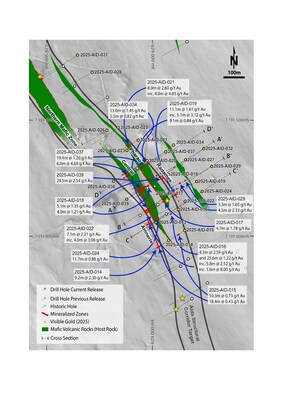
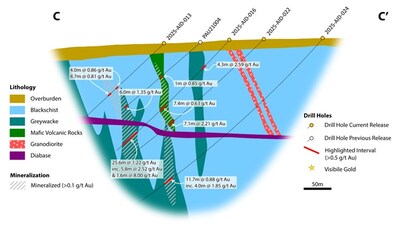
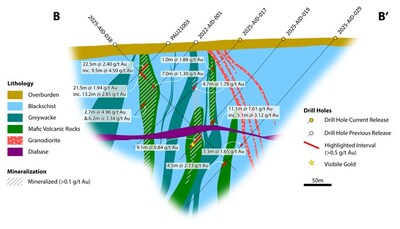
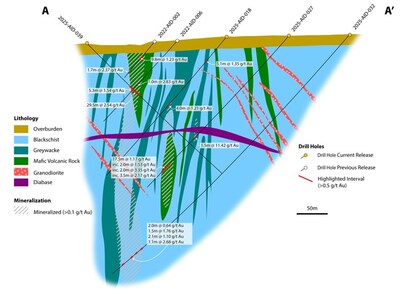
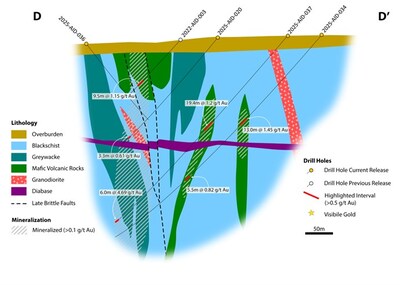
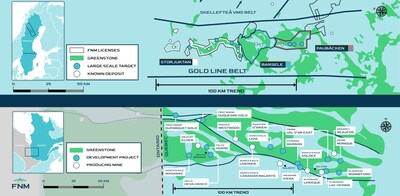
Table 1: Drill hole information for the holes in the current press release.
|
Hole number |
Easting UTM 33 |
Northing UTM 33 |
Elevation |
Depth (m) |
Azimuth |
Dip |
|
2025-AID-013 |
629016 |
7191060 |
452 |
200 |
239 |
-50 |
|
2025-AID-014 |
629076 |
7190982 |
450 |
203 |
240 |
-50 |
|
2025-AID-015 |
629152 |
7191025 |
453 |
248 |
241 |
-50 |
|
2025-AID-016 |
629122 |
7191115 |
455 |
253 |
243 |
-50 |
|
2025-AID-017 |
629138 |
7191201 |
461 |
275 |
237 |
-50 |
|
2025-AID-018 |
629076 |
7191266 |
463 |
296 |
240 |
-50 |
|
2025-AID-019 |
629208 |
7191236 |
462 |
288 |
238 |
-51 |
|
2025-AID-020 |
628974 |
7191325 |
463 |
198 |
240 |
-50 |
|
2025-AID-021 |
628932 |
7191414 |
465 |
197 |
240 |
-50 |
|
2025-AID-022 |
629154 |
7191151 |
459 |
277 |
242 |
-50 |
|
2025-AID-023 |
628885 |
7191375 |
462 |
196 |
241 |
-49 |
|
2025-AID-024 |
629234 |
7191193 |
461 |
452 |
237 |
-50 |
|
2025-AID-025 |
628837 |
7191468 |
464 |
209 |
239 |
-50 |
|
2025-AID-026 |
628784 |
7191457 |
461 |
206 |
239 |
-51 |
|
2025-AID-027 |
629156 |
7191330 |
465 |
335 |
239 |
-50 |
|
2025-AID-028 |
628714 |
7191707 |
463 |
248 |
241 |
-50 |
|
2025-AID-029 |
629279 |
7191301 |
464 |
455 |
240 |
-50 |
|
2025-AID-031 |
628645 |
7191781 |
462 |
317 |
239 |
-50 |
|
2025-AID-032 |
629242 |
7191377 |
467 |
548 |
234 |
-49 |
|
2025-AID-033 |
628539 |
7191925 |
462 |
193 |
237 |
-50 |
|
2025-AID-034 |
629099 |
7191393 |
467 |
399 |
233 |
-49 |
|
2025-AID-035 |
628610 |
7191975 |
466 |
245 |
239 |
-49 |
|
2025-AID-036 |
628816 |
7191237 |
455 |
136 |
60 |
-50 |
|
2025-AID-037 |
629062 |
7191364 |
466 |
351 |
238 |
-51 |
|
2025-AID-039 |
628878 |
7191159 |
452 |
302 |
57 |
-45 |
Table 2: Significant intercepts from drill holes not previously released. All assay results from Aida have now been received by the company.
|
Drill Hole |
From |
To |
width |
Weighted Avg |
|
2025-AID-013 |
95.5 |
99.5 |
4.0 |
0.86 |
|
and: |
112.1 |
120.8 |
8.7 |
0.81 |
|
2025-AID-014 |
60.9 |
69.0 |
8.1 |
2.30 |
|
incl: |
62.0 |
65.5 |
3.5 |
5.42 |
|
2025-AID-015 |
42.4 |
52.7 |
10.3 |
0.73 |
|
incl: |
45.4 |
52.7 |
7.3 |
0.96 |
|
incl: |
42.4 |
46.4 |
4.0 |
0.99 |
|
incl: |
45.4 |
46.4 |
1.0 |
3.41 |
|
incl: |
49.5 |
50.5 |
1.0 |
2.38 |
|
or : |
49.5 |
52.7 |
3.2 |
1.00 |
|
and: |
209.0 |
227.4 |
18.4 |
0.43 |
|
incl: |
215.6 |
216.6 |
1.0 |
1.71 |
|
2025-AID-016 |
68.9 |
73.2 |
4.3 |
2.59 |
|
and: |
218.9 |
244.5 |
25.6 |
1.22 |
|
incl: |
238.8 |
244.5 |
5.8 |
2.52 |
|
incl: |
243.0 |
244.5 |
1.6 |
8.00 |
|
2025-AID-017 |
125.3 |
130.0 |
4.7 |
1.78 |
|
2025-AID-018 |
25.8 |
30.9 |
5.1 |
1.35 |
|
and: |
148.0 |
152.0 |
4.0 |
1.21 |
|
2025-AID-019 |
187.2 |
198.3 |
11.1 |
1.61 |
|
incl: |
187.2 |
192.3 |
5.1 |
3.12 |
|
and: |
230.9 |
240.0 |
9.1 |
0.84 |
|
incl: |
233.0 |
236.0 |
3.0 |
1.64 |
|
incl: |
230.9 |
237.1 |
6.2 |
1.12 |
|
2025-AID-021 |
75.0 |
83.0 |
8.0 |
2.60 |
|
incl: |
78.0 |
82.0 |
4.0 |
4.83 |
|
2025-AID-022 |
209.5 |
216.6 |
7.1 |
2.21 |
|
incl: |
210.5 |
214.5 |
4.0 |
3.06 |
|
2025-AID-024 |
221.6 |
223.6 |
2.0 |
2.02 |
|
and: |
343.0 |
354.7 |
11.7 |
0.88 |
|
incl: |
343.0 |
347.0 |
4.0 |
1.85 |
|
2025-AID-027 |
221.6 |
223.0 |
1.4 |
11.42 |
|
and: |
251.0 |
253.2 |
2.3 |
1.49 |
|
and: |
284.4 |
301.9 |
17.5 |
1.17 |
|
incl: |
291.4 |
293.4 |
2.0 |
3.35 |
|
2025-AID-028 |
61.9 |
66.8 |
5.0 |
0.87 |
|
incl: |
64.9 |
65.8 |
1.0 |
2.67 |
|
2025-AID-029 |
246.2 |
249.5 |
3.3 |
1.65 |
|
and: |
305.5 |
309.0 |
3.5 |
2.92 |
|
2025-AID-032 |
454.0 |
464.7 |
10.7 |
0.63 |
|
2025-AID-034 |
148.6 |
166.6 |
18.1 |
1.17 |
|
Incl: |
157.0 |
158.0 |
1.0 |
10.39 |
|
and: |
261.6 |
267.0 |
5.4 |
0.82 |
|
2025-AID-037 |
154.0 |
175.4 |
21.4 |
1.17 |
|
incl: |
163.4 |
169.4 |
6.0 |
2.25 |
|
and: |
343.2 |
349.2 |
6.0 |
4.69 |
|
2025-AID-039 |
99.4 |
125.7 |
26.4 |
2.80 |
|
incl: |
100.6 |
110.3 |
9.7 |
3.83 |
|
|
|
|
|
|

SOURCE
