Bravo Reports Positive Results from Flotation Test Work
Post completion of the Preliminary Economic Assessment ("PEA", see news release, dated
-
Jameson Cell testing delivered encouraging recovery-to-mass pull* performance relative to the traditional rougher flotation previously recorded.
*Recovery-to-mass pull represents the percentage of mineralized material content to final concentrate relative to feed material.
-
Results exceed data generated using conventional laboratory scale traditional flotation cells.
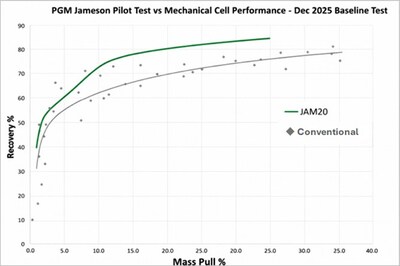
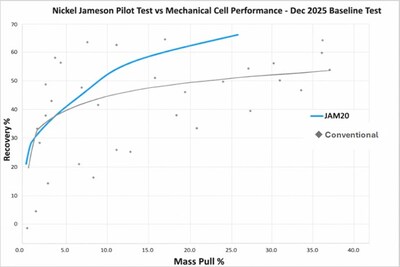
- PGM recoveries improved by 5 - 10% while nickel improved 5 - 30% above baseline conventional cell recoveries, while mass pull reduced by up to 50% - See Figures 1 and 2.
- Results to date suggest potential to achieve lower mass pull and enhanced selectivity, which may result in higher concentrate grades and lower concentrate tonnage for the same payable metal, positively impacting potential future concentrate payabilities and operating costs.
- Nickel recoveries also surprised on the upside, showing potential to further improve future Luanga concentrate value and Luanga project economics.
- Improved rougher stage recovery was observed across the Luanga mineralisation metals suite of platinum group metals (PGM), nickel and gold.
-
Jameson Cell technology is now widely adopted globally, including in PGM operations in southernAfrica , reportedly leading to improved recoveries and concentrate grades, and reductions in capital and operating expenditures. - This technology will be trialled in the subsequent cleaner and scavenger circuit configurations and on samples from the additional mineralized zones.
"The preliminary
Initial results demonstrate that the Jameson Cell achieved improved metal recoveries at significantly reduced mass pull when benchmarked against traditional flotation (conventional) cells. The improved performance is attributed to the better air bubble/mineral contact environment created within the Jameson Cell environment. Results, whilst preliminary in nature, justify continued evaluation of the Jameson technology.
Work streams within on-going metallurgical program include optimisation tests for grinding, reagent dosages, residency times, and circuit configuration. The program scope also considers evaluating various established flotation technologies believed capable of enhanced metal recovery, improving selectivity for a higher-grade concentrate product, reducing circuit complexity, and optimising capital expenditure.
Preliminary Metallurgical Test Work Results
The Company identified an opportunity to further improve metallurgical performance by targeting incremental recoveries from losses of fine-grained mineralisation reporting to final tailings. To this end, the well-established Jameson flotation cell technology has been considered and included in the general test program.
The reported
The Jameson Cell rougher test results plot favourably on the recovery versus mass pull curve when compared with conventional cell rougher tests. Notably, higher recoveries were recorded with a significantly reduced mass pull, translating to the production of a higher-grade concentrate. This improvement over conventional cell performance is attributed to the improved contact between air bubbles and minerals within the Jamson Cell.
While management cautions that results are preliminary, they are considered significant given their apparent improvement compared with historical values. Jameson technology could also produce further upsides, including reduced circulating loads, simplified rougher-cleaning stages and improved overall flotation efficiency.
The Jameson test was conducted as a laboratory-scale rougher flotation exercise using a Jameson L150 cell on a 20kg representative, homogenised, sulphide composite from the
To establish the base line for comparison, a conventional sulphide reagent suite, including PE26 depressant and PAX collector was used to replicate historical parameters. Operating conditions were controlled to optimise the Jameson Cell air bubble mixing intensity, including stable air entrainment, feed density and froth washing.
Figures 1 and 2 show that relative to the comparative baseline assessment data, the Jameson test demonstrated apparent improvements in recovery of 5 - 10% for platinum, palladium and gold. Similarly positive results were reported for nickel recoveries, with a 5 - 30% improvement across the recovery-mass pull curve vs the conventional cells.
Furthermore, this outcome was achieved coincident with a 50% reduction in mass pull, at similar recovery assessment points on the recovery-mass pull curve, which suggest overall higher final concentrate grades may be achieved.
Importantly,
As such, the results provide a robust indication of the expected performance of Jameson cells within a future commercial processing flowsheet. Consequently, Jameson results are accepted as being sufficiently reliable for inclusion in future PFS/FS studies
Mineralogical-Metallurgical Relevance
Previous mineralogical investigations of the Luanga mineralization have determined that a component of the platinum group minerals occurs within a fine size fraction. The collection and flotation kinetics in Jameson cells has been demonstrated to be effective at further improving recovery of minerals in fine fractions, while significantly reducing mass pull, thus further improving the selectivity and concentrate grade.
Relatively small improvements in metallurgical performance (i.e. recovery and grade) have significant impacts on project economics and warrant on-going metallurgical programs. Management believes that further investment in an expanded metallurgical development program to include larger scale (pilot plant) testing is justified.
Jameson Cell Flotation Technology
The Jameson Cell is a high-intensity flotation technology with a long and well-established operating history. Since its first industrial installation in 1989, more than 500 Jameson Cells have been installed globally across a wide range of commodities, including copper, coal, gold, nickel, zinc and platinum group metals. To date, nine units have been installed in platinum group metal concentrators.
Jameson Cells are increasingly utilised in platinum group metal circuits, where fine particle recovery and selectivity is important. In southern
Key advantages of
- High recovery across a wide particle size range, from ultra-fine to coarse material,
- Feed to concentrate conversion (mass pull) reduction, supporting improved concentrate payabilities and reduced logistics costs,
- Reduced footprint and simplified circuit design compared to conventional mechanical flotation cells,
- Lower capital and operating costs due to fewer moving parts and reduced maintenance requirements, and
- Proven scalability from laboratory testing through to large-scale commercial concentrators.
These attributes align closely with Bravo's objective of developing a robust, efficient and capital-conscious processing flowsheet.
Post implementation at its Mogalakwena North Concentrator1, Valterra have reported a reduction in mass pull to concentrate of 23% and an improvement in concentrate grade from 60 g/t to 78 g/t (source).
Other notable, recent installations of Jameson concentrators include Hudbay's New Britannia Concentrator2 (source:), upgrades to the Philex Copper Mine Jameson Concentrator3, Ero Copper's Caraíba Concentrator4 and a planned installation at Vale's Sossego operation in the Carajás,
The Hudbay operation reportedly reduced 11 conventional flotation cells to four Jameson Cells, reducing the plant footprint by 50% and achieved wet commissioning in two days while achieving target metallurgical performance in less than 24 hours. The Philex operation reduced its operating footprint by 67%, reconfiguring from 50 conventional cells to 10 Jameson Cells. Rougher and Scavengers reported a 3.3% and 4.5% recovery improvement in copper and gold flotation, respectively. In
Source links: 1
Valterra
; 2
For additional information, please refer to the following material:
Jameson vs Conventional Flotation Concentrators (
Bravo will continue its metallurgical test work program, with a focus on validating
About
Bravo is a Canadian and
Bravo is one of the most active explorers in Carajás. The team, comprising of local and international geologists, has a proven track record of PGM, nickel, and copper discoveries in the region. They have successfully taken a past IOCG greenfield project from discovery to development and production in the Carajás.
Technical Disclosure
Technical information in this news release has been reviewed and approved by
Neither
Forward Looking Statements.
This news release contains forward-looking information which is not comprised of historical facts. Forward-looking information is characterized by words such as
"potential", "improve", "encouraging", "confirm", "opportunity", "encourage", "significant", "better", "upside", "achieve", variants of these words and other similar words, phrases, or statements that certain events or conditions "may" or "will" occur. This news release contains forward-looking information and interpretations pertaining to the Company's ongoing metallurgical programs, including
the results of Jameson cell tests; the timing and results of planned PFS and, subsequently, any feasibility study (FS), studies; and the Company's plans in respect thereof. Forward-looking information involves risks, uncertainties and other factors that could cause actual events, results, and opportunities to differ materially from those expressed or implied by such forward-looking information. Factors that could cause actual results to differ materially from such forward-looking information include, but are not limited to, unexpected results from exploration programs, changes in the state of equity and debt markets, fluctuations in commodity prices, delays in obtaining required regulatory or governmental approvals, environmental risks, limitations
on insurance coverage; and other risks and uncertainties involved in the mineral exploration and development industry. Forward-looking information in this news release is based on the opinions and assumptions of management considered reasonable as of the date hereof, including, but not limited to, the assumption that the assay results confirm that the interpreted along strike and up and down dip; that activities will not be adversely disrupted or impeded by regulatory, political, community, economic, environmental and/or healthy and safety risks; that the

SOURCE
