ARRAS MINERALS UPDATES ON STRATEGIC ALLIANCE AND OUTLINES EXPLORATION PLAN FOR 2026 IN KAZAKHSTAN
In
Highlights of the two-year generative exploration program include:
- Three new porphyry discoveries along a 54km long porphyry trend running parallel to the Bozshakol Copper-Gold Mine Trend
- Large hydrothermal system defined at
Besshoky Project showing distal porphyry stylealteration and mineralization - Geochemistry: 39,773 soil samples collected across the property
- Geophysics:
- Regional airborne air magnetic survey
- 3,641.71 line-kilometre Heli-EM survey conducted over Package A property and P39 Target (Akkuduk Property). o 181.4 sq km VIP survey conducted o 135.4 line-kilometre Pole-Dipole (P-DP) Inducted Polarization survey completed
- Drilling o 479 Top of Bedrock ("KGK") drill-holes totaling 12,555.2m completed o 18 diamond drill-holes, totalling 5,250.6m drilled to date
- Significant mineralized intercepts returned from 3 targets, including:
- SHID_25_007 – 14.8m grading 0.13% Cu and 0.02 g/t Au
- BOZS_25_001 – 29.0m grading 0.11% Cu and 0.02 g/t Au o TORT_25_003 – 34.0m grading 0.25 g/t Au and 0.02% Cu
Exploration Results – Overview & 2026 Plan
Through 2024-2025, the
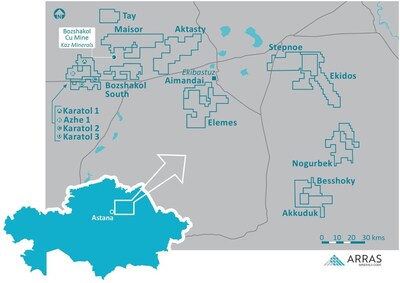
Across the license packages, there is very little to no outcrop with unconsolidated cover usually ranging from a few metres to up to 40m in thickness. Given this, and the sheer size of the combined license packages of approximately 1,900 sq km, the objective of the
The generative program has successfully identified three new porphyry systems, under cover and on a parallel trend to the operating Bozshakol copper-gold mine. The length of this trend is believed to extend at least 54 km and thus the first phase of relatively shallow drilling here will be followed up in 2026. Additionally, at the Besshoky license, a large hydrothermal system was confirmed, with drilling identifying mineralization and alteration peripheral to the core of a porphyry system.
Finally, with focus on copper porphyry systems, the
Package A –
On Package A, in 2024 a Heli-EM survey was completed over the entire property which was designed to discover subsurface electrical conductivity contrasts that could be indicative of mineral deposits and geological structures to prioritize targets for follow-up exploration.
In the western part of the license package, where cover was minimal, a 26,731-soil sampling program was completed. In the eastern part of the license package, where soil cover was thicker, a systematic grid of KGK drilling totaling 479 holes (12,555.2m) was undertaken to identify any mineralization beneath cover and to learn more about the subsurface geology in these areas.
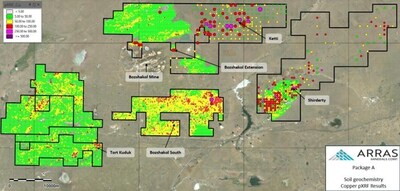
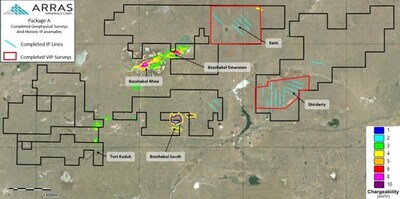
In early 2025, Vector IP and Pole-dipole IP programs were completed over the most prospective targets and diamond drilling across select targets commenced in H2 2025.
Shirderty Target
The KGK drilling outlined a large Cu-Au-Mo-Bi-Te anomaly in a NE-SW striking structural corridor, coincident with a 4km x 3.2km chargeability anomaly identified by the VIP survey.
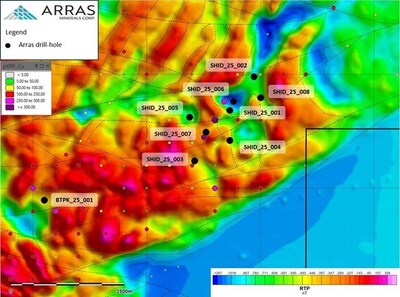
Diamond drilling (8 holes, totaling 2,159.4m) intersected several phases of intrusive rocks and several syn-mineral porphyry dikes hosted in mafic volcaniclastic rocks with extensive hydrothermal alteration with porphyry-style mineralization. Alteration and mineralization were characterized by a core of phyllic alteration with 3-5% disseminated pyrite, with D- and B-Type veins that zone out into an extensive propylitic event characterized by quartz-pyrite-chalcopyrite-albite-chlorite veins. The results are indicative of the peripheral part of a porphyry system, and the 2025 drilling only tested a small part of the target.
Table 1: Selected drill results, Shirderty Target
|
Hole_ID |
mFrom |
mTo |
Interval |
Au g/t |
Ag g/t |
Cu pct |
Mo ppm |
|
SHID_25_001 |
40.00 |
50.00 |
10.00 |
0.03 |
0.3 |
0.10 |
16.7 |
|
SHID_25_006 |
103.70 |
107.20 |
3.50 |
0.03 |
0.5 |
0.10 |
1.6 |
|
SHID_25_007 |
9.00 |
23.80 |
14.80 |
0.02 |
0.1 |
0.13 |
9.3 |
The Company is planning to conduct an MT and Gravity survey over the Shirderty target, with follow-up diamond drilling to explore for the source of porphyry alteration and mineralization and to explore several additional chargeability and KGK geochemical anomalies.
Bozshakol South ("Boz S") Target
The Boz S target is defined by a 3x2km wide chargeability anomaly in Soviet-era data centered on a small gold-barite mineral occurrence that was historically thought to be a volcanogenic massive sulphide deposit. The area was tested with a single IP line that confirmed the size and scale of the historic chargeability anomaly, and sampling identified large soil Cu, As, Mo anomalies coincident with high chargeability zone.
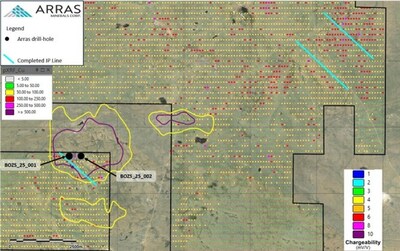
This target was only explored by two wide-spaced drill-holes that intersected an intrusive complex with phyllic and propylitic alteration indicative of the distal part of a porphyry system. Mineralization consisted of disseminated pyrite, with minor magnetite patches with zones of quartz-pyrite-chalcopyrite veins and C-type veins, again supporting the theory that there is a porphyry system in the area.
Table 2: Selected drill results, Boz S Target
|
Hole_ID |
mFrom |
mTo |
Interval |
Au g/t |
Ag g/t |
Cu pct |
Mo ppm |
|
BOZS_25_001 |
188.00 |
217.00 |
29.00 |
0.02 |
0.2 |
0.11 |
16.7 |
|
BOZS_25_001 |
249.00 |
267.00 |
18.00 |
0.07 |
0.3 |
0.11 |
21.1 |
|
BOZS_25_002 |
251.35 |
270.00 |
18.65 |
0.03 |
0.2 |
0.10 |
2.1 |
The target was only partly tested with two holes (593.8 metres) to a depth of 300m. The geophysical and geochemical anomaly is untested to the southwest along a multi-kilometre soil copper anomaly, IP chargeability high and magnetic low, that may represent the magnetite destructive zone that hosts Cu-Au mineralization at other projects in the area. The Company is planning on following up with a gravity and MT survey over the Soviet-era IP anomaly, with follow-up diamond drilling.
Tort Kuduk Target
The Tort Kuduk target is a 1 x 1 km sized Mo-Cu soil anomaly. Follow-up mapping identified several outcropping silicified intrusions with high density stockwork quartz veining and strong potassic alteration.
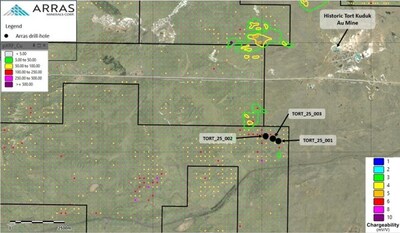
The target was drilled with three wide-spaced drill-holes totaling 893.8m to a maximum depth of 300m, that intersected a porphyritic monzonite hosted in andesites with zones of stockwork A- and B-type veins with k-feldspar halos. Drill-hole TORT25003 intersected a wide zone of silicification and brecciation that returned 34.0m grading 0.25 g/t Au and 113.0 ppm Mo.
Table 3: Selected results from Tort Kuduk Drilling
|
Hole_ID |
mFrom |
mTo |
Interval |
Au g/t |
Ag g/t |
Cu pct |
Mo ppm |
|
TORT_25_003 |
171.00 |
205.00 |
34.00 |
0.25 |
0.4 |
0.02 |
113.8 |
Arras is planning on conducting a ground magnetic survey over the Tort Kuduk target and the large copper geochemical anomaly to the southwest to better define targets for follow-up drilling.
Undrilled Targets
Bozshakol Extension
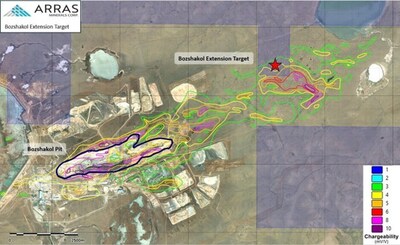
Arras controls an approximate 1.2km extension of the operating Bozshakol copper-gold mine trend which covers a discrete magnetic high surrounded by a large, demagnetized zone, with a coincident historic chargeability anomaly. KGK drilling returned porphyry pathfinder signatures, and magnetic data identified a subtle magnetic high in a large, demagnetized zone, that could be related to the potassic core of a porphyry deposit. An initial drill program with two holes is planned to test this area for porphyry mineralization.
Package B –
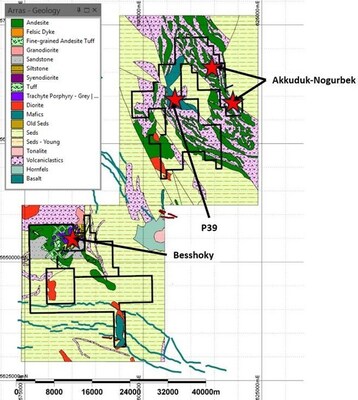
Exploration in the Package B group of concessions focused primarily on the Besshoky license. A small (145.73 line-kilometre) Heli-EM survey was also conducted over the P39 Nickel target on the Nogurbek license.
Besshoky Target
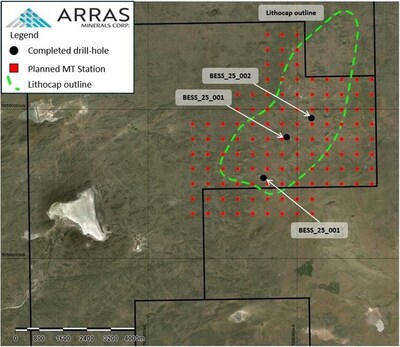
The Besshoky target is a broad hydrothermal system covering >35 sq km with a core of silicification and pyrophyllite-white mica, sericite-quartz-pyrite and grading to chlorite-epidote-magnetite alteration towards the edges of the system.
Soil sampling defined a large Cu-Mo-Bi geochemical anomaly centred on this lithocap. Follow-up IP surveys, totalling 47.5 line-kilometres, identified several large chargeability anomalies beneath and adjacent to it.
In 2025, three wide-spaced holes were drilled in the lithocap. The holes intersected a package of andesitic volcanic breccias and andesite flows with strong sericite-quartz-pyrite alteration with an increase in potassic alteration with depth, suggesting that the core of the system is located towards the south-east part of the lithocap, and was not fully drill tested.
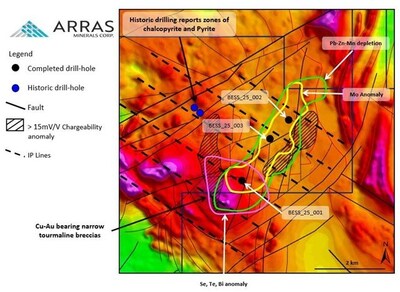
The drilling only partially tested the IP chargeability and geochemistry anomalies. The Company is planning a Magnetotellurics (MT) and Gravity survey over the Besshoky Target to help identify deep targets for follow-up vectoring and drill-testing.
Undrilled Targets
Akkuduk-Nogurbek
The Akkuduk-Nogurbek target received minimal attention in 2025, with work restricted to surface mapping. The Company also surveyed several Soviet era drill-collars in the field and was able to obtain summary reports and sections listing some results from these holes. The historic data indicates that there were significant gold intercepts hosted in diorites, including:
- 30.5 m grading 1.65 g/t Au
- 30.2 m grading 1.07 g/t Au
- 19.8 m grading 1.2 g/t Au
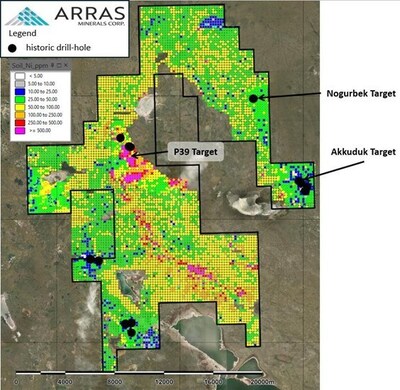
The Akkuduk Target is also highlighted by a minor Cu-Mo soil anomaly with a coincident significant Ni-Mn depletion zone.
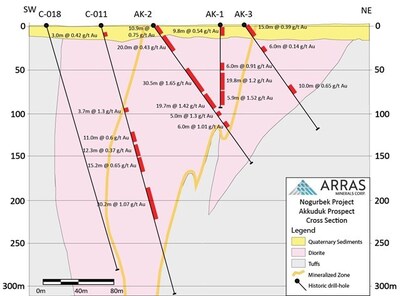
This data suggests that there is good potential for this target to host significant gold mineralization. In 2026 the company will conduct IP surveys over the areas with historic drilling to help identify mineralization and will also follow-up with a drill program focusing on confirming the historic drill data and determine the size potential of this target.
P39
The Company believes that the P39 target may host an orthomagmatic nickel sulphide deposit. Soil sampling in 2023 defined a 14-kilometre-long Ni-Cr-Co anomaly (figure 10) and a small EM survey conducted in 2024 identified a series of subtle EM anomalies coincident with the core of the Ni-Cr zone and may represent sulphide mineralization.
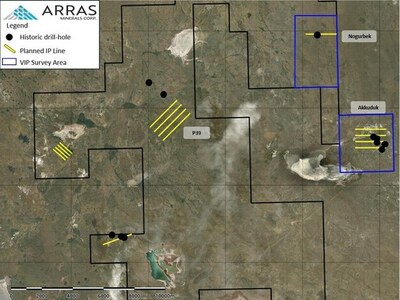
In 2026, the company is planning on conducting a detailed mapping and sampling program, with a focused IP survey over the soil anomalies and EM targets, as well as VIP surveys of the Akkuduk and Nogurbek targets. If the results are positive, this will be followed up with a small drill program.
|
_________________________ |
|
1 Bozshakol Q1, 2025 Report https://www.kazminerals.com/media/23282/q1-2025-production-report_final.pdf |
Issuance of DSUs
The Company has granted an aggregate of 47,018 deferred share units ("DSU") to certain independent directors at a price of
References
Quality Assurance and Quality Control
The Company adheres to CIM Best Practices Guidelines for exploration related activities conducted on its property. Quality Assurance and Quality Control (QA/QC) procedures are overseen by the Qualified Person.
Arras Minerals QA/QC protocols are maintained through the insertion of certified reference material (standards), blanks and field duplicates within the sample stream. Drill core is cut at
Each bagged core sample was shipped to
Gold analysis was conducted by
ALS is an accredited laboratory which is independent of the Company. Chain of custody is maintained from the drill to the submittal into the laboratory preparation facility.
Qualified Person
The scientific and technical disclosure for this news release has been prepared under supervision of and approved by
On behalf of the Board of Directors,
"Tim Barry"
Chief Executive Officer and Director
INVESTOR RELATIONS: +1 604 687 5800
info@arrasminerals.com
Further information can be found on:
- the Company's website https://www.arrasminerals.com or
- follow us on LinkedIn: https://www.linkedin.com/company/arrasminerals or
- follow us on X (formerly Twitter): https://twitter.com/arrasminerals
About
Cautionary note regarding forward-looking statements: This news release contains forward-looking statements regarding future events and Arras' future results that are subject to the safe harbors created under the

SOURCE
