SPC Nickel Identifies Extensive High Conductivity EM Targets at the Muskox Copper-Nickel-PGM Project, Nunavut
The survey has outlined numerous strong conductors, many located along the margins of the Muskox Intrusion and within the Feeder Dyke, that either coincide with known surface Cu-Ni-PGM mineralized zones or define new exploration targets. Preliminary analysis of selected 'Test Areas' has identified several high-priority, high-conductance targets, extending for several hundred metres, that remain untested by drilling. Together, these results reinforce both the scale and prospectivity of the Muskox system and position the Company to advance a focused, data-driven exploration program.
Survey Highlights
- Eighty-five strong electromagnetic conductors identified at the
Muskox Project in 1,410 line-km airborne electromagnetic survey data collected by the Xcalibur HELITEM low-frequency time-domain system. - Many of the strongest EM conductors coincide with the margins of the Muskox Intrusion or occur within the Feeder Dyke and align with zones of known Cu-Ni-PGM sulphide mineralization or represent new exploration targets.
- The modeled anomalies within the two Test Areas indicate very conductive sources that are at or near the upper limits of the conductance resolution of the HELITEM EM system.
HELITEM Survey Results
The survey was flown
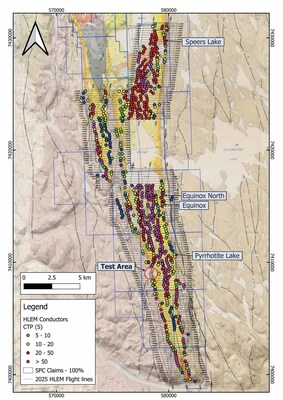
Electromagnetic anomalies were picked, examined and ranked by Xcalibur's proprietary software based on a number of geophysical parameters (X & Z EM responses, decay information and magnetic response). On this basis, each anomaly is assigned a conductor grade between 1 and 6 with 6 being the strongest and 1 being the weakest. A Conductivity-Thickness-Product (CTP) value is then calculated that indicates the strength of each anomaly.
Further modeling of selected conductors within Test Areas in both the North and South Block grids has been completed to refine estimates of their size, conductance, and spatial positions (these Test Areas are shown in Figures 4 and 5). This work serves as an initial test and will be expanded to encompass all priority conductors across both grids. These modeled conductors are being integrated with the 2025 mapping and surface sampling results to refine target ranking and define areas for follow-up exploration.
Muskox Intrusion Grid Results
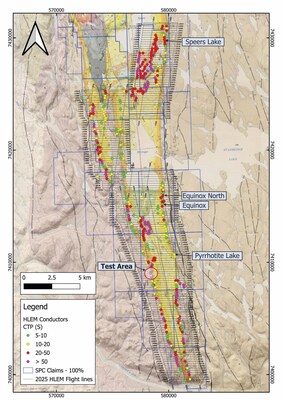
The main body of the Muskox Intrusion was covered by the north grid, consisting of 750 line-km flown on east-west lines spaced 200 metres apart. A total of 780 EM anomalies were identified within this grid, summarized in Table 1 and illustrated in Figure 1. These anomalies have been graded and categorized according to their assigned CTP values, and a filtering process was applied to remove responses interpreted to originate from serpentinized ultramafic lithologies that dominate the central portion of the Intrusion. Post-filtering a total of 490 anomalies are interpreted to be related to prospective horizons within the Muskox Intrusion and the surrounding footwall lithologies (Figure 2).
Table 1: 2025 Main Intrusion EM Anomalies (filtered and unfiltered) graded by Xcalibur and categorized by their CTP values.
|
Conductor |
Conductor CTP |
Number of |
Number of |
|
6 |
>50 |
224 |
83 |
|
5 |
20-50 |
252 |
142 |
|
4 |
10-20 |
110 |
79 |
|
3 |
5-10 |
106 |
99 |
|
2 |
1-5 |
86 |
85 |
|
1 |
0-1 |
2 |
2 |
|
Total |
|
780 |
490 |
|
1. Conductor Grade determined by Xcalibur Multiphysics proprietary software (6 = Strong, 1 = Weak). |
|
2. CTP values measured in siemens (S). |
Muskox Intrusion Test Area (Figure 4)
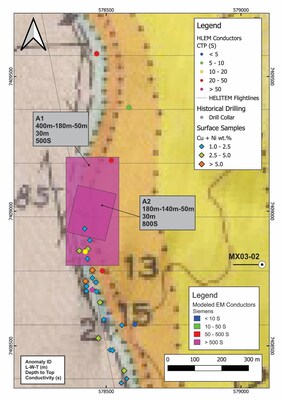
The 500-metre-long test area encompasses a series of high-conductivity airborne EM conductors associated with a pronounced embayment of the intrusion contact along the western margin of the Muskox Intrusion. Detailed modeling of the airborne EM anomalies (Figure 4) on Line 20370 of the north grid shows two untested, large high-conductivity features coincident with the contact of the Muskox Intrusion and high-grade mineralization at surface.
- Anomaly 1 (A1) is modeled as a plate measuring 400 metres by 180 metres with a thickness of 50 metres at a depth of 30 metres below surface. The strength of the anomaly, measured in siemens (S), is 500S.
- Anomaly 2 (A2) is modeled as a plate measuring 180 metres by 140 metres with a thickness of 50 metres at a depth of 30 metres below surface. The strength of the anomaly is 800S and is interpreted to represent the high-conductivity core of the anomaly.
Feeder Dyke Grid Results
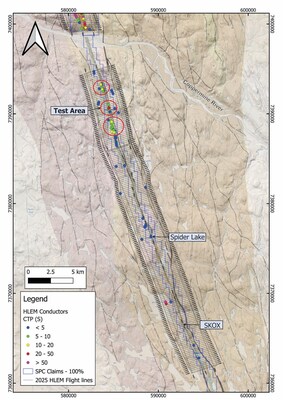
The 60 km long Feeder Dyke was covered by the south grid, consisting of 660 line-km flown on east-west line spaced 200 metres apart. A total of 39 EM anomalies were identified within this grid, summarized in Table 2 and illustrated in Figure 3. These anomalies have been graded and categorized according to their assigned CTP values. No filtering process was applied to the data as serpentinized ultramafic are not present in the survey area (Figure 3).
Table 2: 2025 Feeder Dyke EM Anomalies graded by Xcalibur and categorized by their CTP values.
|
Conductor |
Conductor CTP |
Number of |
|
6 |
>50 |
2 |
|
5 |
20-50 |
2 |
|
4 |
10-20 |
7 |
|
3 |
5-10 |
12 |
|
2 |
1-5 |
16 |
|
1 |
0-1 |
0 |
|
Total |
|
39 |
|
1. Conductor Grade determined by Xcalibur Multiphysics proprietary software (6 = Strong, 1 = Weak). |
|
2. CTP values measured in siemens (S). |
Feeder
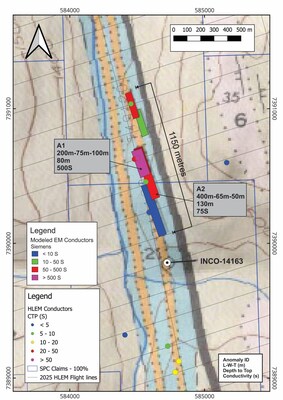
At the northern end of the south grid, a cluster of moderate to high-conductivity anomalies was observed along a 1,150-metre section of the Muskox Feeder Dyke. These anomalies occur within the Feeder Dyke and are aligned parallel to its inferred internal lithological layering.
- Anomaly 1 (A1) is modeled as a plate measuring 200 metres by 75 metres with a thickness of 100 metres at a depth of 80 metres below surface. The strength of the anomaly is 500S and is interpreted to represent the high-conductivity core of the anomaly.
- Anomaly 2 (A2) is modeled as a plate measuring 400 metres by 65 metres with a thickness of 50 metres at a depth of 130 metres below surface. The strength of the anomaly is 75S.
About the Muskox Intrusion
Originally discovered in the 1950s by Inco,
The Muskox Intrusion is one of the largest and least deformed layered mafic to ultramafic bodies in the world. It was emplaced during a large magmatic event (Mackenzie Magmatic Event) in the Proterozoic by mantle plume volcanism related to the widespread
Previous exploration programs completed on
-
7.50 metres @ 6.14% Cu, 2.76% Ni and 9.06 g/t PGM (Pt+Pd+Au)1 by
Silvermet Corporation (2007) and - 13.74 metres @ 5.04% Cu, 2.21% Ni and 5.63 g/t PGM2 by Equinox Resources Ltd. (1987).
These results, combined with an extensive footprint of magmatic sulphide mineralization, historical high-grade drill intercepts, untested geophysical targets and limited modern follow-up, underscore the Project's discovery potential.
|
Reference |
|
1. Vivian, Gary (2007). |
|
2. Page, J.W., Culbert, R.R. and Martin, L.S. (1988). Geochemical, geophysical and diamond drill reports on the Muskox property, NWT. Equinox Resources Ltd. DIAND Assessment report 082562. 56 p., 3 data Appendices. |
Quality Assurance, Quality Control and Qualified Persons
The technical elements of this news release have been approved by Mr.
The historical information shown in this news release was obtained from historical work reports filed by Equinox Resources Ltd. and
About
Cautionary Note on Forward-Looking Information
Except for statements of historical fact contained herein, the information in this news release constitutes "forward-looking information" within the meaning of Canadian securities law. Such forward-looking information may be identified by words such as "plans", "proposes", "estimates", "intends", "expects", "believes", "may", "will" and include without limitation, statements regarding estimated capital and operating costs, expected production timeline, benefits of updated development plans, foreign exchange assumptions and regulatory approvals. There can be no assurance that such statements will prove to be accurate; actual results and future events could differ materially from such statements. Factors that could cause actual results to differ materially include, among others, metal prices, competition, risks inherent in the mining industry, and regulatory risks. Most of these factors are outside the control of
Neither

SOURCE
