Artemis Gold Announces Expanded Phase 2 Development at Blackwater Mine
TSXV: ARTG
- Capital-efficient,
$1.44 billion expanded Phase 2 ("EP2") development of processing capacity to 21 Mtpa expected to be funded from operating cash flow - Over 500,000 ounces of annual gold production expected for first 10 full years, transforming Blackwater into one of the three largest single gold mines in
Canada
(all amounts in Canadian dollars unless otherwise stated)
The Company estimates that EP2 will be completed at a capital cost of
The EP2 project is consistent with the staged development strategy and plan for the
EP2 increases gold production to over 500,000 ounces per year and economies of scale provide for lower unit operating costs, which will cement the
|
______________________________ |
|
|
1 |
Refer to Non-IFRS Measures |
Early works for EP2 are set to commence in
"We look forward to continuing to work collaboratively with our Indigenous partners, local communities and the provincial and federal governments to responsibly develop the
"We are being disciplined in our approach to planning for the successful delivery of EP2, allowing for sufficient time through Q3 2026 to advance engineering and procurement together with early works activities which allow us to hit the ground running when major works construction activities are scheduled to commence in Q3 2026."
Production and Cost Guidance
Based on the Company's currently approved development plans, including the EP2 project, the following table shows long-term production and cost guidance in relation to previously announced updated guidance for 2025. Annual guidance for 2026 will account for additional downtime expected to tie-in the Phase 1A expansion project and is expected to be provided in
|
|
|
|
Expansion period |
First five full years |
First 10 full years |
|
|
Units |
2025 |
2026-2028 |
2029-2034 |
2029-2038 |
|
Annual average gold production |
koz/year |
190-210 |
275-425 |
500-525 |
500-525 |
|
Annual average silver production |
koz/year |
|
600-1,200 |
2,500-3,000 |
2,000-2,500 |
|
Annual average gold eq. production |
koz/year |
|
285-450 |
520-550 |
510-540 |
|
All-in sustaining costs1 |
US$/oz Au |
|
|
|
|
|
1 Refer to Non-IFRS Measures. All-in sustaining costs are presented on an asset level basis and include production costs, selling costs and royalties, sustaining capital costs, equipment finance costs beyond the expansion period, less silver by-product credits and changes in inventory, divided by payable gold ounces. Except for 2025, they do not include regional and corporate general and administrative expense and other non-cash items which may be included in our annual guidance in early 2026 and beyond. |
|
_______________________________ |
|
|
1 |
Refer to Non-IFRS Measures |
Processing plant throughput rates are expected to average between 8 and 9 Mtpa for the next three years with 2026 expected to be at an annual rate of about 6.5 Mtpa until Phase 1A is fully ramped up by the end of 2026. After the expansion period, the processing plant is expected to run at the full production rate of 21 Mtpa, not including any further optimization potential or future Phase 3 expansion. Mill recoveries are expected to average 90% for the next three years and then average 93% after the construction of both the Phase 1A and EP2 circuits.
Expanded Phase 2 Project Update
The EP2 project is consistent with the staged development strategy and plan for the
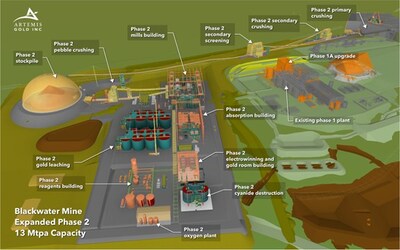
The processing plant for EP2 has a design throughput capacity of 13 Mtpa, which combined with Phase 1A (8 Mtpa) will increase the total throughput capacity of the
The Phase 3 expansion to reach a 25 Mtpa processing rate, referenced in the 2024 Expansion Study, is expected to be largely achieved through continued debottlenecking and optimization of the Phase 1/1A and EP2 processing plants, with only modest further capital requirements anticipated to support these efforts in the future. There is also potential for any Phase 3 expansion to be larger than 25 Mtpa in the future and for mine life extension with re-optimization of the mine plan and potential mineralization expansion. An update to the Mineral Resources and Mineral Reserve estimates is expected in 2026.
The EP2 processing plant is designed as a separate facility located adjacent to the existing Phase 1 processing plant. This will allow for the segregation of Phase 1 operating activities from EP2 construction activities to ensure minimal disruption to current operations during EP2 construction and commissioning.
Front-end engineering and design for EP2 was completed in
Early works activities for EP2 are expected to start in
At the EP2 processing rate, the mine life is expected to be through to 2043, with the final five years of processing from stockpiles. There is also potential to further extend the mine life beyond 2043 and to further expand or optimize processing rates as further described below.
The EP2 project and associated production and cost guidance is based on the
Expanded Phase 2 Processing Plant Design
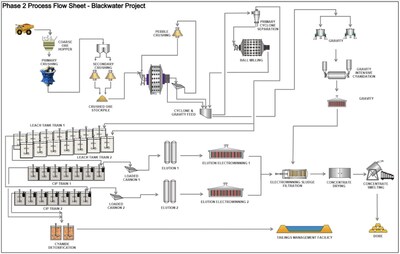
The EP2 processing plant will comprise the following:
- Primary gyratory crusher followed by twin secondary cone crushers, housed in stand-alone structures, with conveyors transporting material between each stage. Crushed material will be stored in a covered crushed ore stockpile and conveyed to the Semi-Autogenous Ball Mill Crusher ("SABC") circuit. The SABC circuit will be used for coarse and fine grinding and will consist of an 18 MW SAG and 18 MW ball mill, with the circuit being closed by cyclones and including a pebble crusher.
- Gravity concentration is incorporated into the grinding circuit design using two centrifugal concentrators with an intensive cyanide leach unit used for recovering gold from the gravity concentrate.
- Two leach and adsorption circuits, which will each consist of both a carbon-in-pulp ("CIP") train and a carbon-in-leach ("CIL") train. The leach and adsorption circuit residence time will be 24 hours, with gravity flow between the between the tanks.
- The loaded carbon will be treated in an AARL elution and electrowinning circuit consisting of two acid wash columns and two elution columns. Electrowinning will be carried out to recover gold and silver from the elution solution, and the resulting metallic values will be dried and smelted into doré bars.
- Detoxification circuit which will carry out cyanide destruction in the final tailings using oxygen and sulfur dioxide.
Operational Overview
Increasing the
- An increase in annual gold equivalent production to approximately 520,000 to 550,000 ounces in the first five full years
- A sustainable reduction in unit operating costs, driven by economies of scale and reduced fixed operating costs per tonne of ore processed
- Improved operational flexibility resulting from two separate processing circuits and a larger mining fleet
The EP2 mine plan considers the use of conventional open pit mining methods (drill-blast-load-haul), like the current operation. The existing mine equipment fleet will be expanded progressively as mining rates increase from the 2025 mining rate of approximately 40 Mtpa to expected peak mining rates of 90-95 Mtpa, in line with the 2024 Expansion Study.
The Company continues to evaluate alternative methods for transportation of waste material to help drive future cost savings, including crushing and conveying, as well electrification of the mine fleet. Decisions on electrification of the mine fleet and alternative methods for transportation will be made in 2026 and will depend on several factors, including securing the necessary long-term power requirements from BC Hydro.
The majority of site infrastructure requirements for EP2 are already in place for Phase 1 and Phase 1A. Certain other facilities will be upgraded or expanded to support EP2 operations.
The costs associated with expanding the mine fleet, continuing to progress tailings and water management infrastructure, as well as other site infrastructure upgrades are in addition to the EP2 capital cost. Annual expenditure estimates for these items will be provided each year and for 2026 will be included as part of our production and cost guidance in
|
________________________________ |
|
|
1 |
Refer to Non-IFRS Measures |
Phase 2 Permitting and Key Dependencies
- BC Hydro – the Company has received certain undertakings from BC Hydro which will secure sufficient supply of green hydropower for EP2. The EP2 investment decision is conditional upon receipt of formal confirmation of that supply, expected in early 2026.
- Permitting – the
Blackwater Mine's Federal and Provincial Environmental Assessment Certificates ("EACs") allow for processing of up to 21.9 Mtpa (60,000 tonnes per day). Alignment is required to theProvincial Mine's Act permit to match the EACs, which is expected to be obtained in 2026, as well as certain minor permits for construction. In the near future, management plans to pursue increased permit limits for processing beyond EP2.
Data Verification
The Qualified Persons,
Additional information on data verification can be found in the Blackwater technical report which is available under the Company's profile on SEDAR+ at www.sedarplus.ca.
Opportunities
The Company expects to evaluate and reoptimize the current mine life, Mineral Resources and Mineral Reserves in 2026 considering the following:
- Future expansions – further expansions beyond EP2, including the Phase 3 expansion to a 25 Mtpa processing rate or beyond, will continue to be evaluated in conjunction with potential mineralization expansion and mine life extension opportunities. This will include both debottlenecking and optimizations of both Phase 1/1A and EP2 processing plants beyond 21 Mtpa as well as additional processing circuits.
-
Margin improvement – the
Blackwater Mine team is focused on continuing to increase mill throughput rates, targeting 10% above Phase 1 design throughput ahead of the Phase 1A expansion. Various other optimization and improvement initiatives are being advanced, including short interval control and hot-seat changes in the mine, and crushing circuit modifications, mill process control and progressing the ore characterization program. -
Material movement alternatives – the Company continues to evaluate longer-term alternative methods for transportation of waste material, electrification of the hauling fleet and automation of hauling operations, each of which could potentially reduce operating costs and in the case of the first two, lower the
Blackwater Mine's greenhouse gas emissions. -
Increased mine life – the current Mineral Reserve estimate is based on a
US$1,400 /oz gold price. By applying a higher gold price for pit design and cut-off grade, some of Blackwater's Mineral Resources could potentially be converted into Mineral Reserves to extend the mine life. - Positive reconciliation - Additionally, the Company continues to see favourable grade control reconciliation during the quarter, with the conversion of material previously classified as waste into low- and medium-grade stockpile material. This low- and medium-grade material is currently being stockpiled for processing later in the mine life.
- Mineralization expansion – based on previous drilling, the mineralization remains open to the north, northwest and at depth. Drilling to test the extension of mineralization beyond the limits of the current reported Mineral Resource estimate is planned in 2026.
-
District exploration – the broader Blackwater land package remains largely under-explored, with over 30 drill targets identified within potential trucking distance of the existing processing facilities. An initial
$5 million regional exploration drill program commenced inOctober 2025 , which is expected to be part of a broader and longer-term regional exploration strategy over the next 5 to 10 years to fully test the highly prospective land package.
Phase 1A Construction Update
Phase 1A, announced in
Some of the Phase 1A enhancements will support further optimization of the existing processing plant and will be brought online in steps ahead of the overall Phase 1A completion date.
Phase 1A engineering, procurement and construction are advancing well. Some minor components have already been commissioned, the 3.5 MW vertical grinding mill has been ordered, and overall, 10 out of the 13 procurement packages have been committed.
During
The benefit of throughput increases from Phase 1A are expected to be realized by the end of 2026.
The Company estimates that Phase 1A will be completed at a capital cost of
Conference Call and Webcast Details
Conference call
Toll-free in
International: +1-647-846-8723
Webcast: https://event.choruscall.com/mediaframe/webcast.html?webcastid=8ycAux2k
The webcast will be available for replay on the Company's website at www.artemisgoldinc.com until
About
Qualified Person
Neither the
Non-IFRS Measures
This press release refers to certain financial measures, such as all-in sustaining cost ("AISC") and AISC margin, which are not measures recognized under IFRS and do not have a standardized meaning prescribed by IFRS. These measures are derived from the Company's financial statements because the Company believes that, in addition to conventional measures prepared in accordance with IFRS, certain investors and stakeholders will use the non-IFRS measures to evaluate the Company's future operating and financial performance. However, these non-IFRS performance measures do not have any standardized meaning and may therefore not be comparable to similar measures presented by other issuers. Accordingly, these non-IFRS performance measures are intended to provide additional information and should not be considered in isolation or as a substitute of performance measures prepared in accordance with IFRS.
AISC in this news release is presented on an asset level basis and include direct production costs, selling costs and royalties, sustaining capital costs, equipment finance costs beyond the expansion period, less silver by-product credits and changes in inventory, divided by payable gold ounces. Except for 2025, they do not include regional and corporate general and administrative expense and other non-cash items which may be included in our annual guidance in early 2026 and beyond.
AISC margin is defined as cash revenue less silver revenue and AISC. AISC margin is divided by the gold ounces sold to arrive at a per-ounce figure.
Cautionary Note Regarding Forward-Looking Information
This press release contains certain forward-looking statements and forward-looking information as defined under applicable Canadian and
These forward-looking statements represent management's current beliefs, expectations, estimates and projections regarding future events and operating performance, which are based on information currently available to management, management's historical experience, perception of trends and current business conditions, expected future developments and other factors which management considers appropriate. Such forward-looking statements involve numerous risks and uncertainties, and actual results may vary. Important risks and other factors that may cause actual results to vary include, without limitation: risks related to ability of the Company to accomplish its plans and objectives with respect to the operations, optimization, enhancement and expansion of the
In making the forward-looking statements in this press release, the Company has applied several material assumptions, including without limitation, the assumptions that: (1) market fundamentals will result in sustained mineral demand and prices; (2) any necessary permits, approvals and consents in connection with the exploration program or the operations and expansion of the Mine will be obtained; (3) financing for the continued operation of the
Appendix
Mineral Resource Estimate
The base case cut-off grade, within the "reasonable prospects of eventual economic extraction" pit shell is 0.20 g/t gold equivalent ("AuEq"), where the AuEq is calculated as AuEq = Au g/t + (Ag g/t x 0.006). At the base case prices, exchange rate and smelter terms a 0.20 g/t AuEq cut-off covers the processing costs of
Mineral Resource Table Showing Sensitivity to Cut-off Grades (base case highlighted)
|
|
|
|
Grades |
Metal |
||||
|
Classification |
Cutoff |
Tonnage |
AuEq |
Au |
Ag |
AuEq |
Au |
Ag |
|
(AuEq g/t) |
(ktonnes) |
(g/t) |
(g/t) |
(g/t) |
(koz) |
(koz) |
(koz) |
|
|
Measured |
0.20 |
427,123 |
0.68 |
0.65 |
5.5 |
9,360 |
8,905 |
75,802 |
|
0.30 |
313,739 |
0.84 |
0.80 |
5.9 |
8,463 |
8,109 |
59,009 |
|
|
0.40 |
238,649 |
0.99 |
0.96 |
6.1 |
7,627 |
7,347 |
46,727 |
|
|
0.50 |
186,687 |
1.15 |
1.11 |
6.2 |
6,881 |
6,656 |
37,333 |
|
|
0.60 |
149,261 |
1.30 |
1.26 |
6.4 |
6,223 |
6,039 |
30,521 |
|
|
0.70 |
120,916 |
1.45 |
1.41 |
6.6 |
5,633 |
5,479 |
25,619 |
|
|
Indicated |
0.20 |
169,642 |
0.56 |
0.51 |
8.5 |
3,046 |
2,766 |
46,578 |
|
0.30 |
123,309 |
0.68 |
0.61 |
10.4 |
2,677 |
2,431 |
41,112 |
|
|
0.40 |
86,473 |
0.81 |
0.74 |
12.4 |
2,264 |
2,057 |
34,419 |
|
|
0.50 |
64,305 |
0.94 |
0.85 |
14.8 |
1,947 |
1,763 |
30,681 |
|
|
0.60 |
50,527 |
1.05 |
0.95 |
17.2 |
1,705 |
1,537 |
27,957 |
|
|
0.70 |
40,317 |
1.15 |
1.03 |
19.6 |
1,493 |
1,340 |
25,458 |
|
|
Measured + Indicated |
0.20 |
596,765 |
0.65 |
0.61 |
6.4 |
12,406 |
11,672 |
122,381 |
|
0.30 |
437,048 |
0.79 |
0.75 |
7.1 |
11,140 |
10,540 |
100,120 |
|
|
0.40 |
325,122 |
0.95 |
0.90 |
7.8 |
9,890 |
9,404 |
81,146 |
|
|
0.50 |
250,992 |
1.09 |
1.04 |
8.4 |
8,828 |
8,419 |
68,014 |
|
|
0.60 |
199,788 |
1.23 |
1.18 |
9.1 |
7,928 |
7,577 |
58,478 |
|
|
0.70 |
161,233 |
1.37 |
1.32 |
9.9 |
7,125 |
6,819 |
51,077 |
|
|
Inferred |
0.20 |
16,935 |
0.53 |
0.45 |
12.8 |
288 |
246 |
6,953 |
|
0.30 |
11,485 |
0.66 |
0.57 |
16.2 |
245 |
210 |
5,971 |
|
|
0.40 |
8,690 |
0.77 |
0.65 |
19.2 |
214 |
182 |
5,373 |
|
|
0.50 |
5,552 |
0.95 |
0.79 |
26.0 |
169 |
142 |
4,648 |
|
|
0.60 |
4,065 |
1.10 |
0.90 |
32.7 |
143 |
118 |
4,279 |
|
|
0.70 |
3,328 |
1.20 |
0.97 |
36.9 |
128 |
104 |
3,951 |
|
|
Notes: |
|
|
1. |
The Mineral Resource estimate was prepared by |
|
2. |
Mineral Resources are reported using the 2014 CIM Definition Standards and are estimated in accordance with the 2019 CIM Best Practices Guidelines. |
|
3. |
Mineral Resources are reported inclusive of Mineral Reserves. |
|
4. |
Mineral Resources that are not Mineral Reserves do not have demonstrated economic viability. |
|
5. |
The Mineral Resource has been confined by a conceptual pit shell to meet "reasonable prospects of eventual economic extraction" using the following assumptions: the 143% price case with a Base Case of |
|
6. |
The AuEq values were calculated using |
|
7. |
The specific gravity of the deposit has been determined by lithology as being between 2.6 and 2.74. |
|
8. |
Numbers may not add due to rounding. |
The following factors, among others, could affect the Mineral Resource estimate: commodity price and exchange rate assumptions; pit slope angles and other geotechnical factors; assumptions used in generating the constraining conceptual pit shell, including metal recoveries, and mining and process cost assumptions. There are no other known factors or issues that materially affect the Mineral Resource estimate other than those disclosed above, and the normal risks faced by mining projects in the province in terms of environmental, permitting, taxation, socio-economic, marketing, and political factors. Additional risk factors are listed in the "Cautionary Note Regarding Forward-Looking Information" section at the end of this news release.
Mineral Reserve Estimate
The Mineral Reserve Estimate for the
Mineral Reserve Estimate
|
Classification |
Run of Mine (Mt) |
AuEq Grade (g/t) |
Gold Grade (Au, g/t) |
Contained Metal (Au, Moz.) |
(Ag, g/t) |
Contained Metal (Ag, Moz.) |
|
Proven |
325.1 |
0.78 |
0.74 |
7.8 |
5.8 |
60.4 |
|
Probable |
9.2 |
0.83 |
0.80 |
0.2 |
5.8 |
1.7 |
|
Total Reserve |
334.3 |
0.78 |
0.75 |
8.0 |
5.8 |
62.2 |
|
Notes: |
|
|
1. |
Mineral Reserves are reported at the point of delivery to the primary crusher, inclusive of mining loss and dilution, using the 2014 CIM Definition Standards, and have an effective date of |
|
2. |
Mineral Reserves are supported by the 2024 Expansion Study life of mine plan. |
|
3. |
The Qualified Person for the estimate is Mr. |
|
4. |
Mineral Reserves are reported at a net smelter return (NSR) cut-off of |
|
5. |
Gold equivalent (AuEq) values are calculated using the same parameters as NSR listed above, resulting in the following equation: AuEq = Au g/t + (Ag g/t x 0.006). |
|
6. |
Numbers have been rounded as required by reporting guidelines. |
Specific risk to the Mineral Reserves include changes to the following factors: metal prices, foreign exchange rates, Interpretations of mineralization geometry and continuity of mineralization zones, geotechnical and hydrogeological assumptions, ability of the mining operation to meet the annual production rate, operating cost assumptions, mining and process plant recoveries, the ability to meet and maintain permitting and environmental license conditions, and the ability to maintain the social licence to operate.
There are no other known factors or issues that materially affect the Mineral Reserve estimate other than those which are disclosed above, and normal risks faced by mining projects in the province in terms of environmental, permitting, taxation, socio-economic, marketing, and political factors and additional risk factors as listed in the "Cautionary Note Regarding Forward-Looking Information".

SOURCE
