The Hackett Group® Survey Finds AI Momentum Accelerates as Enterprises Reimagine Work
2026 Key Issues Study shows AI driving 25%+ improvements across key customer, employee and productivity outcomes
This press release features multimedia. View the full release here: https://www.businesswire.com/news/home/20260128525082/en/
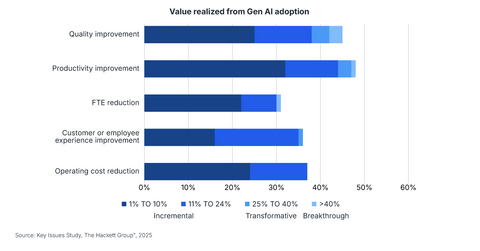
AI investments are paying off: The percentage of organizations reporting transformative levels of value to achieve specific business goals or outcomes is encouraging. A few organizations even report breakthrough quality and productivity gains exceeding 40%. The Hackett Innovation Awards and our work with dozens of organizations on agentic workflows reinforce these findings.
“What distinguishes these leading organizations is how they are leveraging AI to redesign work,” said
How leading organizations are translating Gen AI into enterprise impact
The report’s data shows enterprises are advancing AI across a broad range of objectives. While the magnitude of benefits varies, the percentage of organizations reporting 25%+ improvements is significant and signals growing operational maturity. Key findings:
- AI is reshaping the customer experience: 54% of organizations are scaling AI to improve customer satisfaction and experience, and 76% of these see 25% or greater improvement in key metrics. This signals a broader shift in how enterprises are using AI to deepen engagement, personalize interactions and create new value pathways across the customer life cycle.
- Risk and compliance are entering a new era of maturity: 50% of leaders are scaling AI to strengthen risk management and compliance. These early efforts are paying off: 57% have seen improvements of 25% or more in employee experience.
- Business productivity and workforce experience gains signal AI’s operational maturity: 69% of organizations are scaling AI to improve employee productivity, with 80% reporting gains of 25% or more. Organizations are beginning to design core processes around AI to accelerate decision-making, improve execution efficiency and elevate the employee experience.
Building the foundations for enterprise-scale Gen AI
To move from fragmented adoption to sustained, enterprisewide impact, organizations must strengthen governance, clarify AI talent strategies, simplify foundational processes and technology landscapes, and establish more disciplined approaches to measuring value and performance impact. The Hackett Innovation Award winners highlight what’s possible when companies embrace the generational opportunity to reimagine work with AI. Bosch, Johnson & Johnson, MTN Group, and Roche Turkiye have achieved dramatic reductions in cycle times, significant return on investment (200%-2,500%), and improvements across employee, customer, and clinical experience – demonstrating the potential of agentic workflows to unlock new levels of enterprise value.
The path to the agentic enterprise
The research identifies a set of actions that distinguish performance leaders from those still struggling to unlock value:
- Anchor enterprise strategies in a clear, fact-based assessment of AI opportunities and threats.
- Build robust process intelligence capabilities that expose complex workflows and enable deliberate, high-impact collaboration between human talent and AI agents.
- Take a pragmatic, problem-specific approach, rather than attempting to fix talent, data. or ethics challenges simultaneously.
The future is agentic
According to the study, organizations that act with urgency to evolve their operating models with AI will be best positioned to realize the full potential of the agentic enterprise: faster decision-making, higher productivity, improved customer and employee experiences, and a new competitive advantage.
“What we’re seeing is a clear separation emerging between organizations that treat Gen AI as an efficiency lever and those that recognize it as a catalyst for enterprise-level transformation,” said
About
Trademarks
Cautionary Statement Regarding “Forward-Looking” Statements
This release contains “forward-looking” statements within the meaning of Section 27A of the Securities Act of 1933 as amended and Section 21E of the Securities Exchange Act of 1934, as amended. Statements including without limitation, words such as “expects,” “anticipates,” “intends,” “plans,” “believes,” “seeks,” “estimates,” or other similar phrases or variations of such words or similar expressions indicating, present or future anticipated or expected occurrences or outcomes are intended to identify such forward-looking statements. Forward-looking statements are not statements of historical fact and involve known and unknown risks, uncertainties and other factors that may cause the Company’s actual results, performance or achievements to be materially different from the results, performance or achievements expressed or implied by the forward-looking statements. Factors that may impact such forward-looking statements include without limitation, the ability of
View source version on businesswire.com: https://www.businesswire.com/news/home/20260128525082/en/
Source:
